

Scalp Health: What It Is and Why It Matters
Scalp health explained with sources: what a healthy scalp looks like, how sebum, barrier, pH and microbiome work, why it matters for hair, and when to refer.
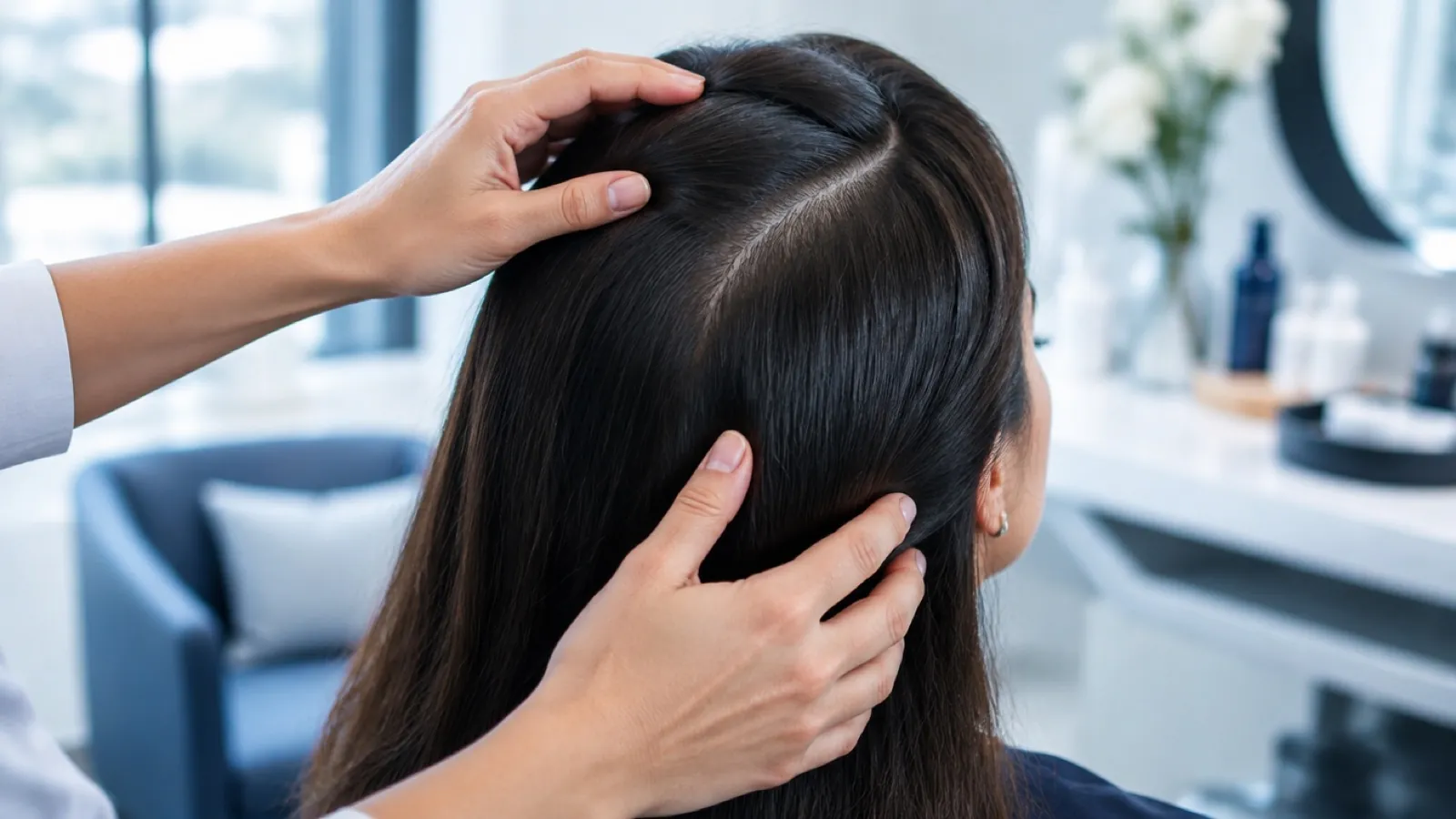
Scalp health is the condition of the skin on your head. A healthy scalp is comfortable, with an intact skin barrier, balanced oil, a stable microbiome, and no persistent flaking, redness, itch, soreness or unexplained hair loss. Because hair grows from follicles set in this skin, scalp health shapes the environment hair forms in.
This guide is written for stylists, barbers and other beauty professionals, and for anyone who wants a sourced answer to "what is scalp health?" It covers what a healthy scalp looks like, how scalp skin works, why it matters for hair, common concerns, daily habits, myths, and when to involve a physician. USTI content is educational and non-medical: recognize, support, refer.
What is scalp health?
Scalp health describes how well the skin of the scalp is doing its normal jobs. Those jobs are the same as skin elsewhere: hold water in, keep irritants and microbes out, shed old cells quietly, and produce enough oil to protect the surface. On the scalp there is one more job, which is to house the follicles that grow hair.
There is no single medical test or score for scalp health. In practice it is judged by a combination of what the person feels (comfort, itch, tightness, soreness) and what can be observed (flaking, redness, oiliness, bumps, changes in hair density).
A useful working definition for professionals has two parts:
- Comfort. No ongoing itch, burning, tightness or tenderness.
- Stability. No persistent flaking, redness, heavy oiliness, sores or unexplained shedding from week to week.
What does a healthy scalp look like?
A healthy scalp looks calm and feels like nothing at all. Under good light or a scalp scope, a professional would expect to see the following signs of a healthy scalp:
- An even color for the person's skin tone, without red, pink, purple or pale patches
- No visible flakes, scale or crusts
- Clear follicle openings without plugs of oil or product
- No bumps, pustules, sores or scabs
- A surface that is neither shiny with oil soon after washing nor tight and dry
- Hair emerging from follicles across the scalp without unexplained thin or bare patches
Appearance varies with skin tone. The American Academy of Dermatology (AAD) notes that the rash of seborrheic dermatitis tends to look red and raised on lighter skin, and pink, slightly purple or lighter than the surrounding skin on darker skin tones. Color change is therefore read against the person's own baseline.
The opposite picture is covered in signs of an unhealthy scalp.
Is the scalp skin? Scalp anatomy in plain terms
Yes, the scalp is skin. It is skin with unusually dense hair, many oil glands and a rich supply of sweat glands. Understanding it as skin is the foundation of scalp care.
The layers
StatPearls, the clinical reference hosted by the US National Library of Medicine, describes five layers to the scalp: the skin, a connective tissue layer, the galea aponeurotica, loose areolar connective tissue, and the pericranium. Scalp care concerns the first of these, the skin.
Epidermis and barrier
The outer part of the skin is the epidermis. DermNet describes its outermost layer, the stratum corneum, as dead, dried-out cells called corneocytes in a "bricks-and-mortar arrangement", held in a matrix of lipids. This is the skin barrier. DermNet states that it works in two directions: an "inside-outside" barrier that regulates water loss, and an "outside-inside" barrier that protects against mechanical, chemical and microbial harm.
Follicles
The Cleveland Clinic defines a hair follicle as a tube-like structure that surrounds the root and strand of a hair. Follicles begin in the epidermis and dermis, and those that hold scalp hair can extend into the tissue beneath. The Cleveland Clinic gives the growth phase of scalp hair, anagen, as two to seven years, with hair growing about 1 centimeter per month. The full cycle is explained in hair growth cycle stages.
Sebaceous glands and sebum
Sebaceous glands sit in the hair follicles and make sebum, the skin's oil. The Cleveland Clinic notes that they are most concentrated on the face and scalp. DermNet describes sebum as a complex mixture of lipids, including glycerides, free fatty acids, wax esters, squalene and cholesterol, that reduces water loss from the skin surface and helps protect the skin from infection by bacteria and fungi. DermNet also states that sebum production is under the control of androgens, and the Cleveland Clinic notes that it rises at puberty and slows gradually after age 70.
pH
DermNet gives the normal pH of the human skin surface as 4.5 to 5.5 and states that this acidity is important to the barrier and helps prevent colonization by pathogens. A 2014 study in the International Journal of Trichology by Gavazzoni Dias and colleagues gives scalp pH as 5.5 and hair shaft pH as 3.67. More detail is in scalp pH explained.
Microbiome
The scalp carries a resident community of bacteria and yeasts. A 2026 study in the journal Life (Guo and colleagues) reports that Cutibacterium and Staphylococcus make up more than 90% of the bacterial community on the scalp, and that Malassezia is the dominant fungal genus. The same paper cites an estimated density of 1,000 to 100,000 microorganisms per square millimeter of scalp. These organisms are normal residents. See the scalp microbiome explained.
Why is scalp health important for hair?
Scalp health is important for hair because the hair fiber is built inside the follicle, below the scalp surface, before it ever emerges. The condition of the surrounding skin is part of the environment the fiber forms in.
The most cited peer-reviewed paper on this question is a 2018 review by Trüeb, Henry, Davis and Schwartz in the International Journal of Trichology, titled "Scalp Condition Impacts Hair Growth and Retention via Oxidative Stress". The authors conclude that "the condition of the scalp affects the natural growth and retention of hair". Their main points:
- Hair can be affected before it emerges from the scalp, and oxidative stress appears to play a role.
- Malassezia, a normal scalp yeast, has been recognized as a source of oxidative damage.
- In dandruff and seborrheic dermatitis, studies report an altered hair cuticle, with surface pitting, roughness and breakage.
- Scalp psoriasis is associated with abnormal hair shafts and decreased hair density in the studies reviewed.
- Poor scalp condition may alter how firmly the fiber is anchored in the follicle.
Two limits belong next to those points. First, this is a review of existing studies, much of it observational, so it shows association more clearly than cause. Second, the paper discloses that three of its authors were employees of a consumer products company that makes shampoo and the fourth was a consultant to it.
What the evidence does not show is that cosmetic scalp care regrows hair. A calm scalp is a better environment for the hair a person has. It is not a hair loss treatment. The research is examined in scalp health and hair growth.
What are the main factors in scalp health?
Six factors account for most of what a professional sees on a scalp. They interact, so a change in one usually shows up in another.
| Factor | What it does | What an imbalance can look like |
|---|---|---|
| Sebum | Reduces water loss and helps protect the surface (DermNet) | Shiny, greasy roots soon after washing, or a tight, dull, dry surface |
| Skin barrier | Holds water in and keeps irritants and microbes out (DermNet) | Dryness, fine flaking, stinging with products |
| Microbiome | Normal residents, mainly Cutibacterium, Staphylococcus and Malassezia (Guo and colleagues, 2026) | Associated in studies with dandruff and seborrheic dermatitis when the balance shifts |
| pH | Skin surface acidity of 4.5 to 5.5 supports the barrier (DermNet) | Not visible directly. Alkaline products can raise friction on the hair fiber (Gavazzoni Dias and colleagues, 2014) |
| Inflammation | The skin's response to irritation, infection or immune activity | Redness or color change, itch, soreness, scale |
| Buildup | Oil, shed skin cells and product residue left on the surface | Dull film, waxy residue at the roots, flakes that are not true dandruff |
Related guides go deeper on single factors: oily scalp causes and care, the scalp exfoliation guide, and scalp types explained, which shows how these factors combine into the working descriptions used in a consultation.
What are the most common scalp concerns?
The most common scalp concerns are flaking, itch, oiliness, dryness, bumps and tenderness. Several different conditions can produce the same signs, which is why professionals describe and refer, and physicians diagnose. The AAD recommends seeing a board-certified dermatologist for diagnosis because many skin conditions produce similar symptoms.
| Concern | What a professional may notice | Who handles it |
|---|---|---|
| Dandruff | Loose white or yellowish flakes, often with itch, without obvious inflammation | Cosmetic care with over-the-counter dandruff shampoo. The AAD advises a dermatologist if it persists or is severe |
| Dry scalp | Small dry flakes, tightness. The Cleveland Clinic describes it as skin that has lost too much moisture | Cosmetic care, such as a gentler shampoo. Physician if it does not settle |
| Product buildup | Dull film or waxy residue near the roots that lifts with cleansing | Cosmetic care |
| Seborrheic dermatitis | Scaly, greasy-looking patches with redness or color change, sometimes past the hairline, at the ears or eyebrows | Physician. Cosmetic support alongside medical care |
| Scalp psoriasis | Well-defined, raised patches with thicker scale | Physician. The AAD states that hair tends to regrow once scalp psoriasis clears |
| Folliculitis | Acne-like bumps at follicles, sometimes with a red ring, itchy or sore (AAD) | Physician |
| Tinea capitis (scalp ringworm) | Scaling with patches of hair loss, sometimes black dots. Mostly in children. Contagious (DermNet) | Physician. DermNet states it always requires systemic medication |
| Sensitive scalp | Stinging, burning or itch with a scalp that looks normal or slightly red | Cosmetic care with gentle products. Physician if persistent |
| Traction | Broken hairs and thinning where hair is pulled tight, soreness, tenting (AAD) | Styling change by the professional. Physician if hair loss is established |
A few sourced facts help with recognition:
- Dandruff and seborrheic dermatitis sit on one spectrum. Borda and Wikramanayake (Journal of Clinical and Investigative Dermatology, 2015) describe dandruff as restricted to the scalp, with itchy, flaking skin without visible inflammation, while seborrheic dermatitis involves inflammation and can affect other areas. See dandruff vs dry scalp vs buildup and the seborrheic dermatitis guide for stylists.
- Scalp psoriasis is common among people with psoriasis. The AAD states that about 50% of people who have plaque psoriasis experience a flare-up on the scalp at some point. See the scalp psoriasis guide for stylists.
- Itch has many causes. The AAD lists ten, including dandruff, reactions to hair care products, head lice, scalp ringworm, psoriasis and nerve problems. See itchy scalp causes.
What daily habits support scalp health?
Daily habits that support scalp health are simple: cleanse the scalp regularly, choose products that suit it, avoid sustained tension and excess heat, protect it from the sun, and act early on changes. None of these is a medical treatment. They are basic skin care applied to the scalp.
- Wash at a frequency that suits the scalp and hair. The AAD says that people with straight hair and an oily scalp may want to shampoo every day, while people with dry, textured, curly or thick hair can shampoo when needed, at least once every 2 to 3 weeks.
- Shampoo the scalp, not just the hair. The AAD advises applying shampoo to the scalp instead of the entire length of the hair.
- Condition the lengths. The AAD notes that conditioner moisturizes and detangles, applied to the ends for fine or straight hair and to the full length for dry or curly hair.
- Rinse thoroughly. The AAD lists incomplete rinsing of shampoo as one reason for an itchy scalp.
- Keep tension low. The AAD states plainly: "If your hairstyle feels painful, the style is too tight." Early signs are covered in traction alopecia early signs.
- Limit heat. The AAD advises low or medium heat settings and limited use of blow dryers and hot tools.
- For dandruff, follow the label. The AAD lists zinc pyrithione, salicylic acid, sulfur, selenium sulfide, ketoconazole and coal tar as dandruff shampoo ingredients and advises following the directions on the bottle.
- Notice change. New flaking, itch, soreness or shedding that lasts is a reason to ask a professional, and often a physician.
A fuller routine is laid out in how to improve scalp health.
What are the common myths about scalp health?
Most scalp health myths come from treating the scalp as something other than skin, or from expecting cosmetic care to do a medical job.
Myth: flakes mean a dirty scalp. The AAD states that seborrheic dermatitis is not caused by unclean skin and is not an allergy. The AAD attributes dandruff to several possible reasons, including some medical conditions, hair care habits and oily skin.
Myth: flaking scalp conditions are catching. The AAD states that seborrheic dermatitis is not contagious. Tinea capitis is a different matter: it is a fungal infection and is contagious, which is one reason diagnosis matters.
Myth: frequent washing always harms the scalp. A 2021 paper in Skin Appendage Disorders (Punyani and colleagues) studied Asian populations without scalp disease and reported that daily washing was superior to weekly washing on the endpoints measured, and that concerns about "overcleaning" were unfounded in that group. Three of the five authors were affiliated with a consumer products company, and the findings may not transfer to every hair type. The AAD's guidance to match frequency to hair type still applies.
Myth: an oily scalp is an unhealthy scalp. Sebum is normal and protective. Oiliness becomes a concern when it arrives with flaking, itch, color change or discomfort.
Myth: a healthy scalp guarantees hair growth. Many causes of hair loss are hormonal, genetic, autoimmune or related to general health. Scalp care supports the skin. It does not replace a medical evaluation of hair loss.
Myth: scalp massage is proven to grow hair. The study most often quoted (Koyama and colleagues, Eplasty, 2016) involved nine men. It is discussed with its limits in scalp health and hair growth.
When should you see a physician about your scalp?
See a physician, ideally a board-certified dermatologist, when a scalp concern persists, worsens or comes with hair loss. Professionals refer on the same signs. The AAD notes that dandruff that persists after home care may be seborrheic dermatitis, psoriasis, a fungal infection of the scalp or eczema.
Signs that call for a medical opinion:
- Flaking or itch that continues despite a period of appropriate home care
- Constant itching, a rash, or a scalp that feels swollen, warm or painful (Cleveland Clinic)
- Thick scale, crusting, bleeding, sores or pus bumps
- Patches of hair loss, especially with scaling, in a child
- Burning, tenderness or pain with hair loss. The Cleveland Clinic notes that scarring alopecia can cause permanent hair loss and that early care may stop inflammation before a follicle is destroyed
- Any new or changing spot on the scalp. The AAD lists skin cancer among the causes of an itchy scalp
- Sudden or rapidly progressing shedding
For professionals, the referral process is covered in when to refer a client to a dermatologist.
How do professionals learn scalp health?
Professionals learn scalp health through structured education that covers skin science, product knowledge, recognition of common conditions and clear referral rules. A stylist or barber sees the same scalps every few weeks, which makes them well placed to notice early change, provided they know what they are looking at and where their role ends.
USTI offers a Scalp Health and Hair Care Science Certification Program designed for hairstylists, barbers, cosmetologists, educators and beauty professionals. Its eleven modules cover scalp and hair anatomy, hair damage, scalp types and scalp care, product categories, ingredient science, building product recommendations, early signs of hair loss and when to refer, common scalp diseases, chemical services, the flaking scalp in depth, and nutrition support. A capstone of case studies and a practice assessment follows. It is available online at your own pace or live on Zoom with USTI educators, and carries 10 Continuing Education credits through USTI. Details are in the scalp health certification guide.
The legal position is straightforward. A scalp health certificate is a professional credential, not a medical license. Certified professionals do not diagnose or prescribe, and hands-on services may fall under state cosmetology or barber rules.
Scalp health, in short, is skin health in a place where hair grows. Know what healthy looks like, understand the factors behind it, support it with sound cosmetic care, and send medical questions to a physician.
New to the field? Start with What is trichology? or look up a term in the trichology glossary.
Sources
- Trüeb RM, Henry JP, Davis MG, Schwartz JR. Scalp Condition Impacts Hair Growth and Retention via Oxidative Stress. International Journal of Trichology, 2018
- Gavazzoni Dias MFR and colleagues. The Shampoo pH can Affect the Hair: Myth or Reality? International Journal of Trichology, 2014
- Guo and colleagues. Scalp Microbiome Composition in Young Women: Associations with Scalp Type, Sensitivity, and Lifestyle Factors. Life, 2026
- Borda LJ, Wikramanayake TC. Seborrheic Dermatitis and Dandruff: A Comprehensive Review. Journal of Clinical and Investigative Dermatology, 2015
- Punyani S and colleagues. The Impact of Shampoo Wash Frequency on Scalp and Hair Conditions. Skin Appendage Disorders, 2021
- Koyama T and colleagues. Standardized Scalp Massage Results in Increased Hair Thickness. Eplasty, 2016
- Tajran J, Gosman AA. Anatomy, Head and Neck, Scalp. StatPearls
- DermNet: Skin barrier function
- DermNet: Sebum
- DermNet: Tinea capitis
- Cleveland Clinic: Hair follicle
- Cleveland Clinic: Sebaceous glands
- Cleveland Clinic: Dry scalp
- Cleveland Clinic: Scarring alopecia
- American Academy of Dermatology: Tips for healthy hair
- American Academy of Dermatology: How to treat dandruff
- American Academy of Dermatology: Seborrheic dermatitis overview
- American Academy of Dermatology: Seborrheic dermatitis causes
- American Academy of Dermatology: 10 reasons your scalp itches
- American Academy of Dermatology: Scalp psoriasis and hair loss
- American Academy of Dermatology: Hairstyles that pull can lead to hair loss
- American Academy of Dermatology: Folliculitis
Frequently asked questions
What is scalp health?
Scalp health is the overall condition of the skin on your head. A healthy scalp feels comfortable, has an intact skin barrier, makes a balanced amount of oil, carries a stable community of microbes, and shows no persistent flaking, redness, itch, soreness or unexplained hair loss. The scalp is skin, so it follows the same rules as skin elsewhere.
What does a healthy scalp look like?
A healthy scalp usually has an even color for the person's skin tone, no visible flakes or crusts, no shiny greasy film shortly after washing, and no bumps, sores or tender spots. Follicle openings look clear, and the scalp feels comfortable between washes. Appearance varies with skin tone and hair type, so comfort and stability matter as much as looks.
Why is scalp health important for hair?
Hair grows from follicles that sit in scalp skin, so the condition of that skin is the environment hair forms in. A 2018 review in the International Journal of Trichology concluded that scalp condition affects the natural growth and retention of hair, and linked dandruff, seborrheic dermatitis and psoriasis with changes to the hair fiber.
Is the scalp skin?
Yes. The scalp is skin with a very high number of hair follicles and oil glands. StatPearls lists five scalp layers, with skin as the outermost. The Cleveland Clinic notes that sebaceous glands are most concentrated on the face and scalp. That is why skin science, including barrier, pH and microbiome, applies directly to the scalp.
How often should you wash your scalp?
It depends on your hair and scalp. The American Academy of Dermatology says people with straight hair and an oily scalp may want to shampoo every day, while people with dry, textured, curly or thick hair can shampoo when needed, at least once every 2 to 3 weeks. The AAD also advises applying shampoo to the scalp.
Can a stylist or barber diagnose a scalp condition?
No. Diagnosis and medical treatment belong to physicians. A stylist, barber or trichology professional can observe the scalp, describe what they see, provide cosmetic scalp care within their license, and refer the client to a dermatologist. The AAD recommends seeing a board-certified dermatologist for diagnosis, because many scalp conditions look alike.
When should you see a doctor about your scalp?
See a dermatologist or physician if flaking continues after home care, or if you have constant itching, a rash, pain, swelling, warmth, sores, pus bumps or patches of hair loss. The AAD notes that persistent dandruff may be seborrheic dermatitis, psoriasis, a fungal infection of the scalp or eczema, which need a medical diagnosis.
Where can professionals learn scalp health?
The United States Trichology Institute offers a Scalp Health and Hair Care Science Certification Program for hairstylists, barbers, cosmetologists, educators and beauty professionals. It has eleven modules plus a capstone, runs online at your own pace or live on Zoom with USTI educators, and carries 10 Continuing Education credits through USTI.
This article is educational and is not medical advice. USTI teaches professionals to recognize, support and refer.
Become the scalp health expert in your chair.
USTI's scalp health and haircare certification program covers eleven modules, online at your own pace or live virtual, with 10 CE credits.
See the scalp health certificationRelated articles
How to Improve Scalp Health: A Step by Step Routine
How to improve scalp health in nine sourced steps: how often to wash, how to shampoo, managing flakes, sun care, and when a scalp problem needs a physician.
Itchy Scalp Causes: 10 Reasons and When to Refer
Itchy scalp causes explained with sources: the AAD's ten reasons, itch without dandruff, itch with hair loss, itch after coloring, and what a stylist can do.
Oily Scalp: Causes, Care and When to Refer
Oily scalp explained with sources: how sebum is made, what drives oil production, how often to wash oily hair, care approaches, and when to refer a client.