

Scalp Exfoliation: How to Exfoliate Your Scalp Safely
Scalp exfoliation explained: physical vs chemical methods, salicylic acid, how often to exfoliate, who should skip it, and the professional service steps.
Part of the USTI scalp health guide. Start with What is scalp health?
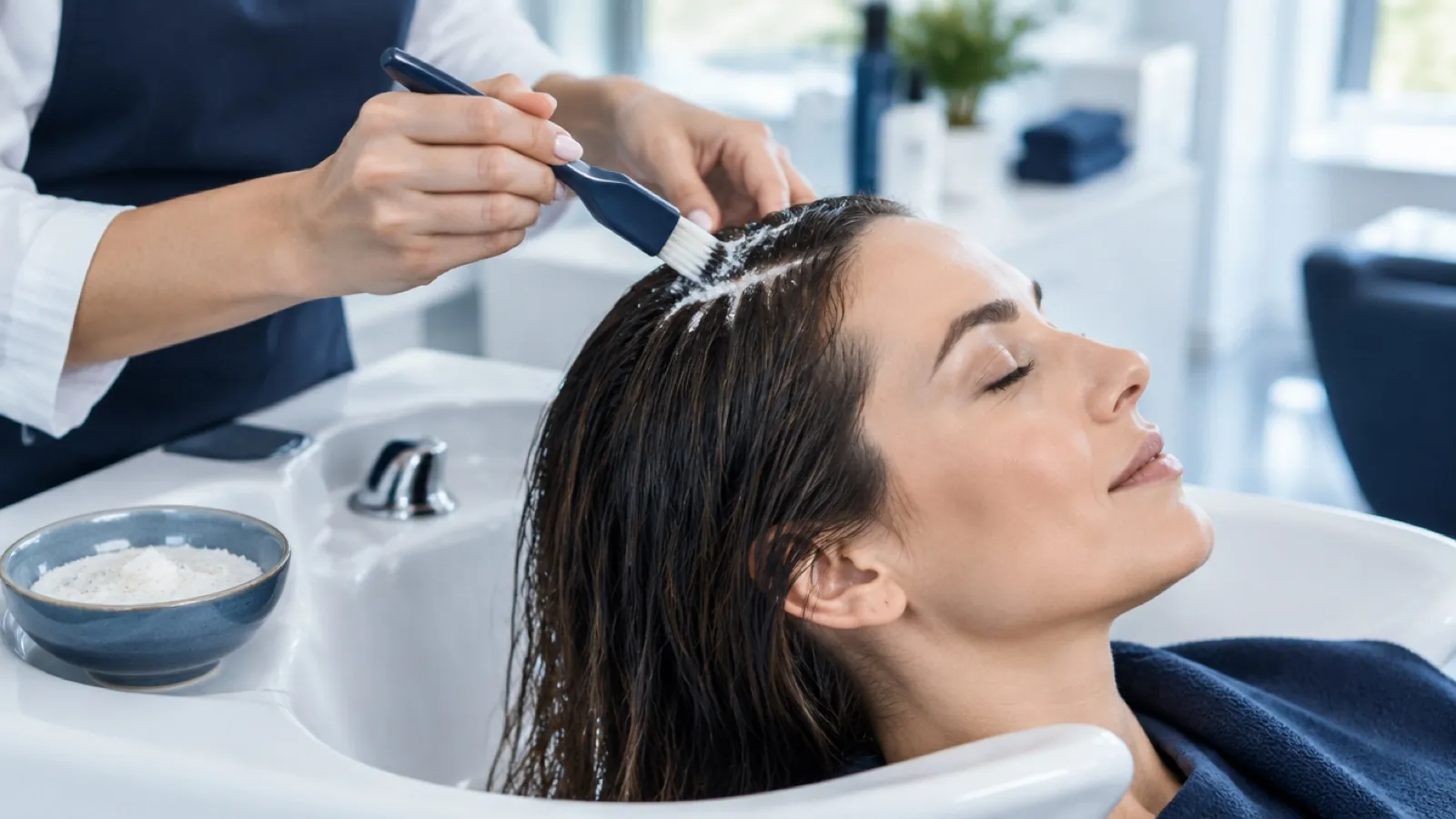
Scalp exfoliation is the cosmetic removal of dead skin cells, excess oil and product residue from the surface of the scalp. It is done with a physical method, such as a scalp scrub or brush, or a chemical method, such as salicylic acid. Done gently and occasionally, it leaves the scalp clean and comfortable.
Exfoliation is one part of overall scalp health, and not every scalp needs it. This guide covers scalp exfoliation benefits, chemical vs physical scalp exfoliation, what salicylic acid does, how often to exfoliate, who should see a physician instead, and the steps of a professional service.
What is scalp exfoliation?
Scalp exfoliation is exfoliation applied to the skin of the scalp. The American Academy of Dermatology (AAD) defines exfoliation as "the process of removing dead skin cells from the outer layer of your skin". On the scalp, that surface layer mixes with oil, sweat and styling product, and exfoliation helps lift the mixture away.
It is a cosmetic step. It cleans the surface of the skin. It does not treat disease, and a flaking scalp that keeps returning needs more than a scrub. To work out what kind of flakes you are looking at, see dandruff vs dry scalp vs buildup.
What are the benefits of scalp exfoliation?
The benefits of scalp exfoliation are cosmetic: a cleaner scalp surface, fewer visible loose flakes and less product residue. Realistic benefits include:
- Scalp buildup removal. Heavy stylers, oils and dry shampoo can leave residue that an ordinary wash does not fully lift.
- Fewer visible flakes. Loose surface flakes are lifted and rinsed away.
- A fresher feel. Many people find the scalp feels lighter and cleaner afterward.
- A clean surface for the rest of the routine. Shampoo and scalp care products meet skin instead of residue.
Be careful with bigger promises. Exfoliation does not regrow hair, and it does not replace medical care for a scalp condition. The link between scalp condition and hair is real and is covered in scalp health and hair growth, but a scrub alone is not a hair growth method.
Chemical vs physical scalp exfoliation: what is the difference?
Physical exfoliation removes dead cells by rubbing. Chemical exfoliation loosens them with an ingredient. The AAD describes the two methods this way: mechanical exfoliation uses a tool, such as a brush, pad or sponge, or a scrub to physically remove dead skin cells, while chemical exfoliation uses chemicals, such as alpha and beta hydroxy acids, to dissolve dead skin cells.
| Physical exfoliation | Chemical exfoliation | |
|---|---|---|
| How it works | Rubbing lifts dead cells and residue | An ingredient loosens dead cells so they rinse away |
| Common forms | Scalp scrub, scalp brush, silicone massager | Salicylic acid shampoos, pre-wash liquids and serums with hydroxy acids |
| Feel | Immediate, textured | Little or no rubbing |
| Suits | Resilient scalps with visible product buildup | Oily or flaky scalps, dense or textured hair where scrubs are hard to rinse |
| Watch for | Too much pressure, scratching, grit left in the hair | Stinging, dryness, using it too often |
| Avoid when | The scalp is sore, broken, sunburned or inflamed | The scalp is sore, broken, sunburned or inflamed |
A scalp scrub is the most familiar physical option. Choose fine, even particles and use light pressure. With dense, curly or coily hair, rinsing a scrub out can take time, which is one reason many people in that group prefer a liquid chemical exfoliant.
What does salicylic acid do for the scalp?
Salicylic acid loosens dry, scaly skin so that it can be washed away. DermNet classes it among the keratolytics and explains that it works by softening keratin, a protein that forms part of the skin structure. DermNet notes that salicylic acid preparations range in strength from 0.5% up to 30%, depending on the use.
On the scalp, salicylic acid appears in two kinds of product, and the difference matters:
- Cosmetic scalp products, sold to cleanse and exfoliate.
- Over-the-counter dandruff products, which are regulated as drugs. The FDA rule for these products, 21 CFR 358.710, lists salicylic acid at 1.8 to 3 percent as an active ingredient for the control of dandruff, seborrheic dermatitis and psoriasis.
The labeling section of the same rule, 21 CFR 358.750, requires warnings on these products, including: "If condition worsens or does not improve after regular use of this product as directed, consult a doctor." For shampoos, the directions read: "For best results use at least twice a week or as directed by a doctor."
The AAD also lists salicylic acid among the ingredients to look for in a dandruff shampoo, and notes that a product containing salicylic acid can soften thick, stubborn patches of scalp psoriasis.
DermNet lists precautions. Mild stinging may occur, especially on broken skin and at higher concentrations. Salicylic acid should not be used on irritated, infected or reddened skin, should be kept away from the eyes, and should not normally be used in children younger than 2 years. Because it is absorbed through the skin, DermNet advises caution in pregnancy and breastfeeding.
For professionals, the practical point is this: you can explain what a salicylic acid scalp product does and how the label says to use it. Deciding whether a client has seborrheic dermatitis or psoriasis is a physician's job. For more on reading actives, see how to read hair product ingredient labels.
How do you exfoliate your scalp at home?
To exfoliate your scalp at home, work on a wet scalp, use light pressure, keep it brief and rinse thoroughly. The AAD's general exfoliation advice is to be gentle, using small circular motions for about 30 seconds, then rinsing with lukewarm water.
- Check the scalp first. If there are cuts, sores, sunburn or soreness, do not exfoliate.
- Wet the hair and scalp with lukewarm water.
- Section the hair so the product reaches the skin, not just the hair.
- Apply the product to the scalp. For a scrub, use a small amount per section. For a chemical exfoliant, follow the label for amount and timing.
- Massage lightly with the pads of the fingers in small circles. No nails.
- Rinse thoroughly. The AAD notes that an itchy, flaky scalp can be a sign that shampoo was not rinsed out well, and the same care applies here.
- Shampoo and condition as usual, with shampoo on the scalp and conditioner on the hair.
- Notice how the scalp feels over the next day. Comfort is the goal. Stinging or tightness means it was too much.
How often should you exfoliate your scalp?
There is no single medical rule for how often to exfoliate the scalp. The AAD says that how often you exfoliate depends on your skin type and the method you use, and that the more aggressive the exfoliation, the less often it needs to be done.
A sensible approach:
- Follow the label. It is written for that formula.
- Start low. Try occasional use, then adjust to how the scalp responds.
- Match it to the scalp. An oily scalp with heavy product use generally tolerates more than a dry or sensitive one. See scalp types explained.
- Back off at the first sign of irritation. Redness, stinging and tightness are signals to stop.
More is not better. The AAD cautions that over-exfoliating can leave skin red and irritated, and that aggressive exfoliation may lead to dark spots in people with darker skin tones.
What is a scalp detox?
"Scalp detox" is a marketing term for a deep cleanse of the scalp. In practice it means some combination of a clarifying shampoo, an exfoliating product and massage, aimed at scalp buildup removal.
It is a useful service name, as long as the promise stays honest: the result is a cleaner scalp surface. If buildup is a regular problem, the lasting fix is usually in the routine, such as how often the scalp is washed and how much product reaches it. How to improve scalp health sets out that routine.
Who should not exfoliate their scalp?
Some scalps should not be exfoliated, and some need a physician instead. Skip exfoliation and seek medical advice in these situations:
- Open cuts, sores or sunburn. The AAD says never to exfoliate if you have open cuts or wounds or if your skin is sunburned.
- Suspected psoriasis. The AAD states that rubbing, scrubbing and scratching the scalp can worsen existing psoriasis, that picking off scale can cause a flare, and that forcefully removing scale often loosens hair along with it. See the scalp psoriasis guide for stylists.
- Suspected infection. DermNet describes tinea capitis, a fungal infection of the scalp, as contagious and as always requiring systemic medication, because topical agents cannot reach the root of the hair follicle. Signs include scaly patches with hair loss, broken hairs that look like black dots, and painful boggy swellings with pustules.
- Sudden pimple-like bumps. The AAD describes folliculitis as an infection of the hair follicles that can look like a sudden acne breakout.
- Irritated or reddened skin. DermNet advises against using salicylic acid on irritated, infected or reddened skin.
- Skin already made sensitive by other products. The AAD notes that some medications and over-the-counter products, such as prescription retinoid creams and products containing retinol or benzoyl peroxide, can make skin more sensitive or cause peeling, so take extra care if these are in use near the hairline.
- Persistent or severe flaking. The AAD says to see a board-certified dermatologist if dandruff does not go away with dandruff shampoo.
In each case, diagnosis and treatment belong to a physician. Exfoliating over an undiagnosed problem can irritate the skin and delay proper care.
What are the steps of a professional scalp exfoliation service?
A professional scalp exfoliation service follows the same principles as home care, with analysis before it and education after it. A stylist or barber provides it as a cosmetic service, within state cosmetology or barber rules, and does not diagnose or treat disease.
- Consultation. Ask about the scalp: itch, flaking, sensitivity, products used, wash frequency, any diagnosis the client chooses to share.
- Scalp analysis. Examine the scalp by eye and under magnification. Scalp analysis for hairstylists covers the method.
- Decide whether to proceed. If you see sores, thick scale, pustules, patches of hair loss or marked redness, do not exfoliate. Explain what you observed in plain terms and refer. See when to refer a client to a dermatologist.
- Choose the method. Match physical or chemical exfoliation to the scalp type, hair density and sensitivity.
- Section and apply. Work in clean partings so the product reaches the scalp evenly. Follow the manufacturer's timing.
- Massage with light pressure. Pads of the fingers, steady rhythm, no nails.
- Rinse thoroughly, then shampoo and condition.
- Finish and recheck. Look at the scalp again, with before and after images if you use a scope.
- Home care and rebooking. Give a short written routine and suggest when to return, based on how the scalp responded.
- Record it. Note the product, timing and the client's response for next time.
Scalp exfoliation is often the anchor of a wider menu. How to add scalp treatments to a salon menu shows how it fits. The knowledge behind good decisions at steps 2 to 4 is taught in the USTI Scalp Health & Hair Care Science Certification Program, which covers scalp types, ingredient science, the flaking scalp and when to refer.
Scalp exfoliation works best as an occasional, gentle step on a scalp that is otherwise healthy. Choose the method to suit the scalp, follow the label, stop if it stings, and send anything that looks medical to a physician.
New to the field? Start with What is trichology? or look up a term in the trichology glossary.
Sources
- American Academy of Dermatology: How to safely exfoliate at home
- DermNet: Salicylic acid
- 21 CFR 358.710: Active ingredients for the control of dandruff, seborrheic dermatitis, or psoriasis (Cornell Legal Information Institute)
- 21 CFR 358.750: Labeling of drug products for the control of dandruff, seborrheic dermatitis, or psoriasis (Cornell Legal Information Institute)
- American Academy of Dermatology: How to treat dandruff
- American Academy of Dermatology: Scalp psoriasis shampoos, scale softeners and other treatments
- American Academy of Dermatology: Scalp psoriasis, 10 ways to reduce hair loss
- American Academy of Dermatology: 10 reasons your scalp itches and how to get relief
- American Academy of Dermatology: Folliculitis
- DermNet: Tinea capitis
Frequently asked questions
What is scalp exfoliation?
Scalp exfoliation is the cosmetic removal of dead skin cells, excess oil and product residue from the surface of the scalp. It is done physically, with a scrub, brush or massager, or chemically, with ingredients such as salicylic acid that loosen dead cells. It is a cleansing step and does not treat any medical condition.
How often should you exfoliate your scalp?
There is no single medical rule. The American Academy of Dermatology says exfoliation frequency depends on skin type and method, and that more aggressive exfoliation needs to be done less often. Follow the product label, start with occasional use, and cut back if you notice redness, stinging or tightness.
Is a scalp scrub or a chemical exfoliant better?
Neither is better for everyone. A scalp scrub gives instant physical lift and suits a resilient scalp with visible buildup. A chemical exfoliant, such as a salicylic acid product, works without rubbing and spreads easily through dense hair. Sensitive scalps usually do better with the gentlest option used less often.
Is salicylic acid good for the scalp?
Salicylic acid is a well established scalp ingredient. DermNet describes it as a keratolytic that softens keratin and helps loosen dry, scaly skin. The FDA rule for over-the-counter dandruff products lists it at 1.8 to 3 percent. DermNet advises against using it on irritated, infected or reddened skin.
What is a scalp detox?
Scalp detox is a marketing term, not a medical one. In practice it means a deep cleanse: a clarifying shampoo, an exfoliating product or a professional service that lifts oil, flakes and product residue from the scalp. The realistic result is a cleaner, fresher feeling scalp.
Who should not exfoliate their scalp?
Skip exfoliation if the scalp has open cuts, sores or sunburn, which the American Academy of Dermatology names as times never to exfoliate. Anyone with suspected psoriasis, infection, painful bumps, thick scale or patches of hair loss should see a physician first. Scrubbing can worsen scalp psoriasis, according to the AAD.
Can a stylist offer scalp exfoliation as a service?
Scalp cleansing and exfoliating services are cosmetic services that licensed beauty professionals commonly provide. The exact services allowed depend on your state's cosmetology or barber rules, so check with your state board. The professional analyzes the scalp first and refers the client to a physician if anything looks medical.
This article is educational and is not medical advice. USTI teaches professionals to recognize, support and refer.
Become the scalp health expert in your chair.
USTI's scalp health and haircare certification program covers eleven modules, online at your own pace or live virtual, with 10 CE credits.
See the scalp health certificationRelated articles
How to Improve Scalp Health: A Step by Step Routine
How to improve scalp health in nine sourced steps: how often to wash, how to shampoo, managing flakes, sun care, and when a scalp problem needs a physician.
Itchy Scalp Causes: 10 Reasons and When to Refer
Itchy scalp causes explained with sources: the AAD's ten reasons, itch without dandruff, itch with hair loss, itch after coloring, and what a stylist can do.
Oily Scalp: Causes, Care and When to Refer
Oily scalp explained with sources: how sebum is made, what drives oil production, how often to wash oily hair, care approaches, and when to refer a client.