

Hair Miniaturization: What It Is and What Stylists See
Hair miniaturization is the gradual shrinking of follicles so they grow shorter, finer hairs. What it may look like under a scalp scope and when to refer.
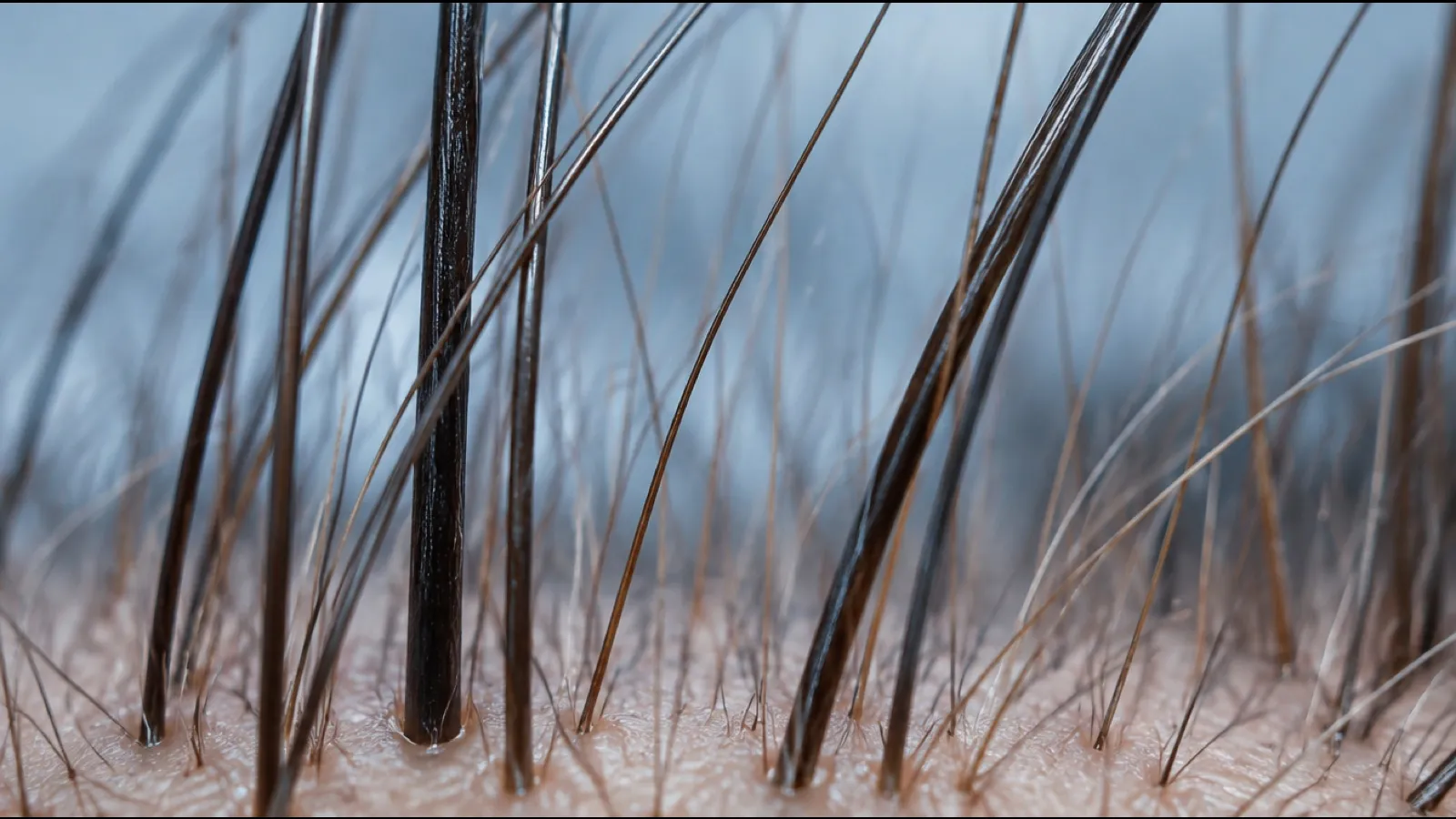
Hair miniaturization is the gradual shrinking of hair follicles so that each one grows a shorter, finer hair than it did before. It is the defining change in androgenetic alopecia, the pattern hair loss that affects both men and women, and it often starts long before a client notices thinning.
For stylists and barbers, miniaturized hair is one of the most useful things to learn to recognize. You handle hair by the section and can feel when the top no longer matches the back. This article explains the process in plain English, what it may look like under a scalp scope, and why it calls for a medical evaluation instead of a product recommendation.
What is hair miniaturization?
Hair miniaturization is a process in which a follicle becomes smaller over repeated growth cycles and produces thinner, shorter, often lighter hairs. Researchers describe it as a stepwise change that turns thick terminal hairs into fine vellus-like hairs. The follicle is still present, but its output shrinks.
MedlinePlus explains the background this way. A scalp hair normally grows for two to six years, rests for several months, then falls out and is replaced. In androgenetic alopecia, follicles in affected areas produce shorter and thinner strands, and the growth of new hair to replace shed strands is delayed.
Two terms help:
- Terminal hair: the thick, pigmented hair that makes up a normal head of hair.
- Vellus hair: very fine, short hair. A 2024 systematic review of trichoscopy describes vellus hairs as 0.03 mm or less thick.
Miniaturization is the slide from the first kind toward the second. For the cycle itself, see hair growth cycle stages.
What causes miniaturized hair?
Miniaturized hair is most closely tied to androgenetic alopecia. MedlinePlus states that this condition is related to hormones called androgens, particularly dihydrotestosterone (DHT), and that variations in the AR gene, which makes the androgen receptor, are involved. Inherited sensitivity in certain scalp areas appears to drive the change.
MedlinePlus estimates androgenetic alopecia affects 50 million men and 30 million women in the United States. It can begin as early as the teens, and risk rises with age. The American Academy of Dermatology (AAD) describes female pattern hair loss as progressive, meaning it tends to continue over time.
Mixed hair thickness is not unique to one condition, and a client can have more than one thing going on. That is one reason a stylist's observation is a starting point and a medical evaluation is the next step.
What are the early signs of hair thinning a stylist can notice?
Early signs of hair thinning from miniaturization are subtle: the top feels finer than the back, the part looks wider, the scalp shows through under bright light, or styles no longer hold the same volume. Clients often report that the hair "will not grow" or feels different, not that it is falling out.
Signs of hair thinning by eye and by feel
- A section from the top feels thinner between your fingers than a section from the occipital area
- The part line is wider than in older photos
- More scalp shows at the crown or temples under the station light
- Shorter, wispy hairs on top that never reach the length of the rest
- A ponytail or fade that needs a different approach than a year ago
Why shedding is a poor guide
Miniaturization and shedding are different things. The AAD says shedding 50 to 100 hairs a day is normal. A client with miniaturization may shed a normal amount while each replacement hair comes back finer. So "I am not losing much hair" does not rule out pattern thinning. The difference is covered in hair shedding vs hair loss.
What does hair miniaturization look like under a scalp scope?
Under magnification, miniaturization may appear as hairs of clearly different thickness growing side by side, more fine short hairs, and more follicle openings holding one hair. Dermatologists call the mixed thickness hair diameter diversity. In a salon these are observations to record, not findings to interpret.
Dermatologists use a formal method called trichoscopy. The published criteria give a sense of what they look for:
- Hair diameter diversity. A 2021 study in Medical Archives notes that thickness variation affecting more than 20% of hairs in the androgen-dependent area is considered a major diagnostic criterion. In that study of 104 people with androgenetic alopecia (60 men and 44 women), all 104 showed uneven hair thickness.
- Thin hairs. The same literature treats more than 10% thin hairs, under 0.03 mm, in the frontal area as a major criterion.
- Other features. The study reported yellow dots in about 53% of patients, vellus hairs in about 49%, and darker skin around follicles in about 40%.
- Front versus back. A 2024 systematic review in the Journal of Clinical Medicine found these features are more prominent in the frontal area than at the occiput.
That last point is practical. With a scalp scope, compare the top or front against the back of the same client's head. If the hairs on top look noticeably more mixed in thickness than those at the back, that is worth photographing and mentioning.
A caution. Those percentages are medical criteria applied by trained clinicians with calibrated equipment. A salon scope cannot measure hair to a hundredth of a millimeter, and a stylist should never count hairs and announce a result. Say what you see: "The hairs up here look finer and more mixed than the ones at the back." For technique, see scalp analysis for hairstylists.
How do male vs female pattern hair loss differ?
Male and female pattern hair loss share the same underlying miniaturization but show it in different places. Men usually recede at the temples and thin at the crown. Women usually thin across the top with a widening part while the frontal hairline stays in place.
| Male pattern hair loss | Female pattern hair loss | |
|---|---|---|
| Typical start | Above both temples (MedlinePlus) | Top of the head (MedlinePlus) |
| Hairline | Recedes into an M shape | Does not typically recede |
| Crown or part | Crown thins, may progress to baldness | Middle part widens |
| Extent | Can lead to partial or complete baldness | Rarely leads to total baldness |
| Usual timing | Can begin in the teens; more than half of men over 50 have some degree (MedlinePlus) | For most women, begins in midlife, in the 40s, 50s or 60s (AAD) |
| What a barber or stylist may notice first | Temples and crown harder to blend; finer hair on top | Wider part; less volume on top |
Barbers are often the first to see the crown, since few men ever look at their own. The trichology for barbers article covers that conversation.
Why does miniaturization call for a medical evaluation?
Miniaturization calls for a medical evaluation because finer, mixed-thickness hair has more than one possible cause, pattern hair loss tends to progress, and only a clinician can assess the full picture. The AAD says a dermatologist can tell which type of hair loss a person has, and different types need different care.
There are three reasons to refer and not guess:
- Look-alikes exist. Other conditions can thin the top of the scalp. Some are scarring and urgent. See the types of hair loss field guide.
- Health context matters. MedlinePlus notes androgenetic alopecia in women is associated with polycystic ovary syndrome, and in men with several other medical conditions. Those are questions for a physician.
- Timing matters. The AAD describes pattern hair loss as progressive and notes that care tends to work better when started early.
What you say can be simple: "The hair on top looks finer than at the back, and that is different from last year. I cannot tell you why. A dermatologist can, and it is worth asking sooner." Decisions about any treatment belong to the client and their doctor. Clients who want non-medical support alongside that visit can use the Find a Trichologist directory.
How can stylists and barbers learn to spot hair miniaturization?
Look at the same areas on every client, compare front to back, and keep dated photos. Hair miniaturization is gradual, so a record is what makes it visible. Formal training gives you the vocabulary and the limits.
USTI's trichology pathway begins with the Hair Loss Practitioner course, then Associate Trichologist, then Clinical training. It teaches observation, documentation and referral, not diagnosis. Recognizing miniaturized hair early, saying so with care, and sending the client to a physician is the most useful thing a hair professional can do about it.
New to the field? Start with What is trichology? or look up a term in the trichology glossary.
Sources
- MedlinePlus Genetics (NIH): Androgenetic alopecia
- Kasumagic-Halilovic E. Trichoscopic Findings in Androgenetic Alopecia. Medical Archives, 2021 (Europe PMC)
- Kuczara A, et al. Trichoscopy of Androgenetic Alopecia: A Systematic Review. Journal of Clinical Medicine, 2024 (Europe PMC)
- American Academy of Dermatology: Female pattern hair loss
- American Academy of Dermatology: Hair loss, who gets and causes
- American Academy of Dermatology: Do you have hair loss or hair shedding?
Frequently asked questions
What is hair miniaturization?
Hair miniaturization is the gradual shrinking of a hair follicle. Each growth cycle, the follicle produces a shorter and thinner hair than before, until a thick terminal hair is replaced by a fine, short, vellus-like hair. It is the central feature of androgenetic alopecia, also called male or female pattern hair loss.
What does miniaturized hair look like?
To the eye, miniaturized hair shows up as less density, more visible scalp and a wider part. Under a scalp scope it may appear as fine, short, pale hairs growing next to thicker ones, and more openings with a single hair. These are observations only. A dermatologist uses trichoscopy and other tests to interpret them.
What causes hair miniaturization?
According to MedlinePlus, androgenetic alopecia is related to hormones called androgens, particularly dihydrotestosterone (DHT), and to inherited factors including variations in the AR gene. Hair follicles in certain scalp areas respond by producing shorter, thinner strands, and new growth is delayed. A physician is the right person to assess the cause in any individual.
Is hair miniaturization the same as hair shedding?
No. Shedding is hair falling out, and the American Academy of Dermatology says losing 50 to 100 hairs a day is normal. Miniaturization is a change in the hairs that grow: they come back finer and shorter over time. A client can have miniaturization with little noticeable shedding, which is why it is often missed early.
Can a stylist diagnose miniaturization with a scalp scope?
No. A stylist or barber can observe and photograph hairs of mixed thickness and share that with the client. Diagnosis is made by a dermatologist or physician, who may use trichoscopy criteria, medical history, blood tests or a biopsy. A scalp scope in a salon is an observation and education tool, not a diagnostic device.
How is male pattern hair loss different from female pattern hair loss?
MedlinePlus describes male pattern loss as a hairline that recedes from the temples into an M shape with thinning at the crown, sometimes progressing to baldness. In women, hair thins at the top of the head and the part widens, the hairline does not typically recede, and total baldness is rare.
What should a stylist do when they see signs of hair thinning?
Describe the change in plain words, document it with dated photos, and suggest the client see a dermatologist or physician. Do not name a condition or recommend a treatment. The American Academy of Dermatology notes that a dermatologist can identify the type of hair loss, which matters because different types need different care.
This article is educational and is not medical advice. USTI teaches professionals to recognize, support and refer.
Turn this knowledge into a certification.
Learn hair and scalp science with USTI educators, from your first course to clinical training.
Explore trichology coursesRelated articles

Alopecia Areata: A Stylist's Guide to Bald Patches
Alopecia areata explained for stylists: the signs you may spot first, what to say when you find a bald patch on a client, cosmetic support and when to refer.
CCCA Hair Loss: Early Signs Every Stylist Should Know
CCCA hair loss often starts quietly at the crown. Learn the early signs a stylist may notice, how it differs from traction alopecia, and when to refer.
Hair Growth Cycle Stages: Anagen, Catagen, Telogen, Exogen
The hair growth cycle stages explained for stylists: anagen, catagen, telogen and exogen, how long each lasts by source and what the cycle means at the chair.