

Hair Shedding vs Hair Loss: What Stylists Should Know
Hair shedding vs hair loss explained for stylists and barbers: what is normal, what telogen effluvium looks like in the chair, and when to refer a client.
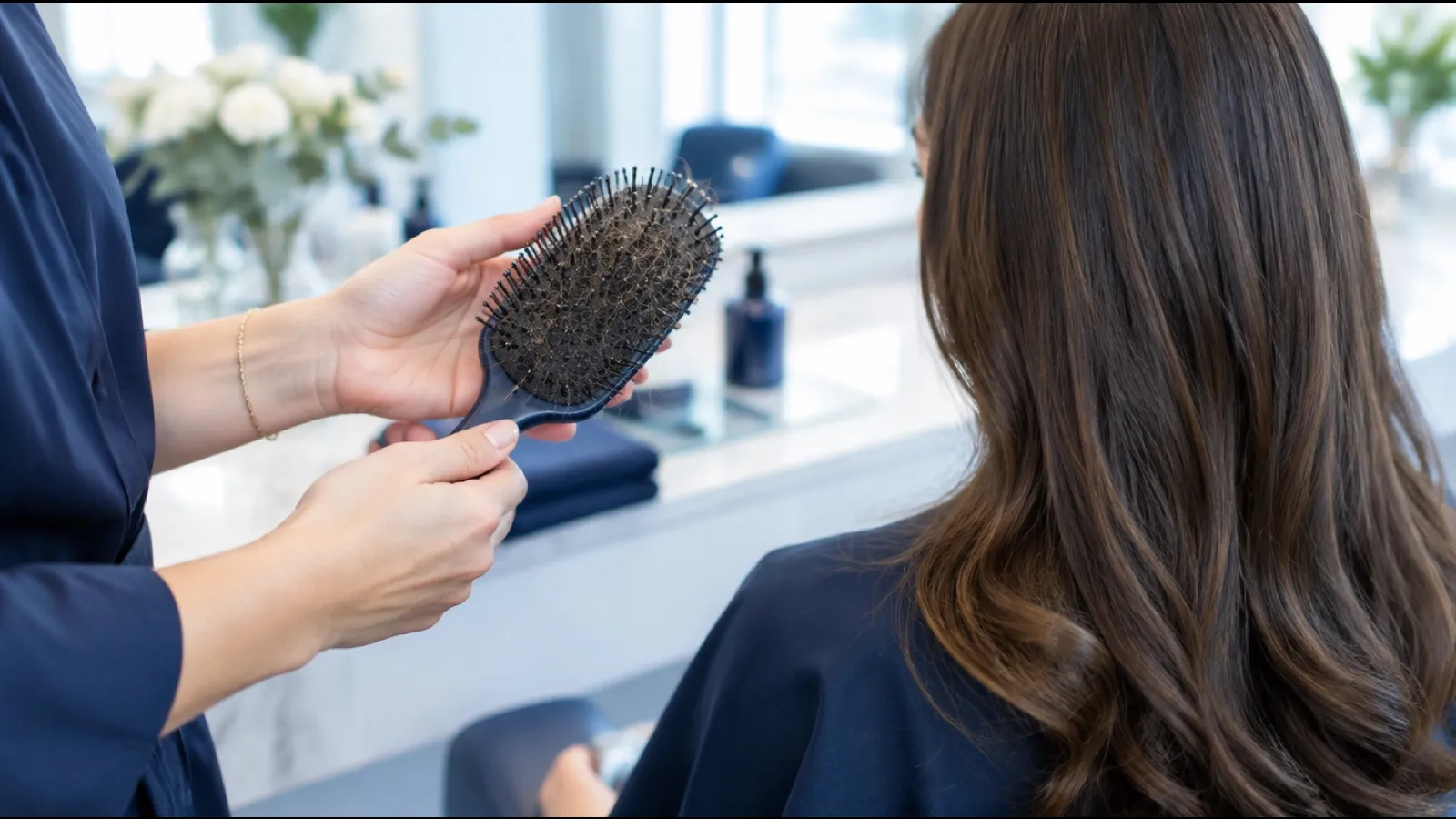
Hair shedding vs hair loss comes down to one question: are hairs falling out faster than usual, or has something stopped the hair from growing? The American Academy of Dermatology (AAD) calls the first excessive shedding, or telogen effluvium, and the second hair loss. Shedding often corrects itself. Hair loss does not reverse until its cause stops.
Clients rarely use those words correctly. They say "my hair is falling out" for both. You are often the first person to see the change, and what you say next shapes whether they panic, ignore it, or get the right help. This guide covers what each one looks like from behind the chair and what to do about it.
How much hair shedding is normal?
The AAD says it is normal to shed between 50 and 100 hairs a day. Shedding is part of a healthy growth cycle: old hairs release so new ones can grow. A client who washes less often will see several days of shed hairs at once, which looks alarming but may be perfectly ordinary.
That last point matters in the salon. A client who shampoos once a week or wears a long-term style will release an accumulated week or more of shed hair in one session. Before you raise a concern, ask about:
- Wash frequency. How many days of normal shedding are in this bowl?
- Baseline. Is this more than they usually see, and for how long?
- Timeline. Did anything significant happen two to four months ago?
A change from the client's own normal is more useful than any count.
What are the hair growth cycle stages?
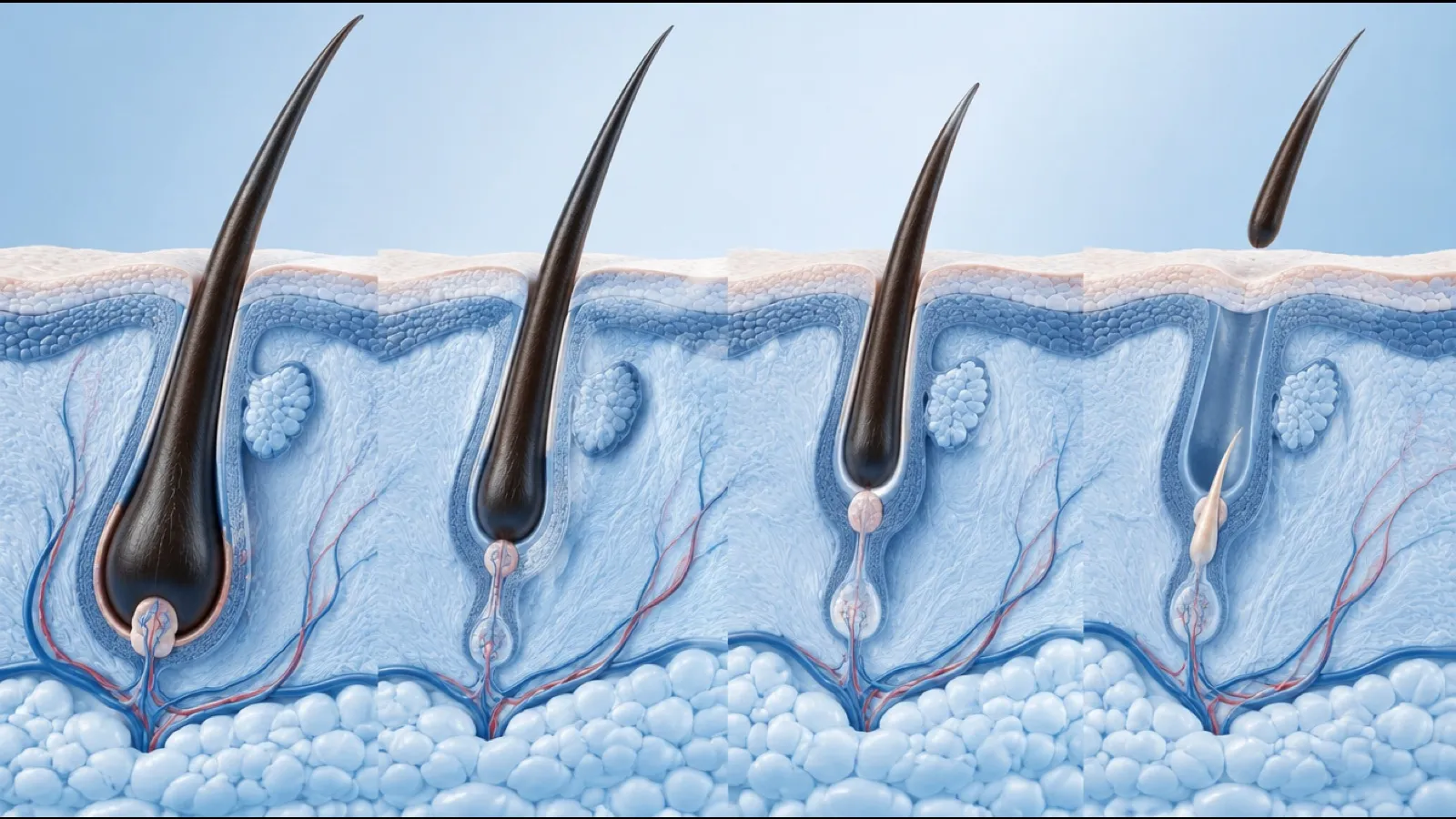
Each follicle cycles through a growth phase (anagen), a short transition phase (catagen) and a resting phase (telogen) that ends with the hair being released. Follicles cycle independently, so on a healthy scalp most hairs are growing at any moment and only a small share are resting.
| Phase | What happens | Approximate duration (scalp hair) | Share of hairs |
|---|---|---|---|
| Anagen | The follicle actively grows the hair fiber | About two to eight years (J Clin Med review, 2023). Cleveland Clinic describes growth for up to four years | Around 80% to 90% (Cleveland Clinic) |
| Catagen | Growth stops and the follicle transitions toward rest | About two weeks (J Clin Med review, 2023) | Around 5% (Cleveland Clinic) |
| Telogen | The follicle rests, then the hair sheds and a new cycle begins | About two to three months (J Clin Med review, 2023) | Around 5% (Cleveland Clinic); about 9% (J Clin Med review, 2023) |
Sources differ on the exact figures, which is why they are best quoted as ranges. The practical lesson is the telogen delay. A hair pushed into rest today sheds two to three months later. That gap is why clients almost never connect the shedding to its trigger.
What is telogen effluvium?
Telogen effluvium is the medical term for excessive shedding. Cleveland Clinic describes it as a type of temporary hair loss caused by a stressor or change to the body, with shedding that tends to start two to three months after the event. More follicles than usual enter the resting phase together, then release together.
The AAD lists these common stressors:
- Losing 20 pounds or more
- Giving birth
- Significant stress, such as caring for a sick relative, divorce or job loss
- High fever
- Surgery
- Recovering from an illness, especially one with a high fever
- Stopping birth control pills
Cleveland Clinic adds thyroid disorders, restrictive diets and certain medications, and notes a person with telogen effluvium may lose up to 300 strands a day.
What it tends to look like in the chair
- Shedding is spread across the whole scalp, not concentrated in one pattern or patch.
- The client reports a sudden start they can roughly date.
- The ponytail feels thinner, but the hairline and part look similar to before.
- A few months later, you may see short new hairs of similar length across the scalp.
The AAD says that as the body readjusts, the shedding stops, and within six to nine months hair tends to regain its normal fullness. It also warns that if the stressor stays, shedding can be long lived. Cleveland Clinic classifies shedding that lasts longer than six months as chronic. That is a referral point.
Postpartum hair loss: how long does it last?
Postpartum shedding is a form of telogen effluvium. The AAD says it is caused by falling estrogen levels, usually peaks about four months after giving birth, and that most women regain their normal hair growth by their child's first birthday. It is temporary shedding, and the AAD describes it as normal.
New mothers often arrive frightened. What helps:
- Name it accurately. "Dermatologists call this excessive shedding. The AAD says it is common after birth and usually peaks around month four."
- Give the timeline. Most women are back to normal by the first birthday.
- Style for it. Adjust the cut and part to work with regrowth along the hairline, and keep tension low.
- Set the referral marker. The AAD advises seeing a dermatologist if hair has not regained normal fullness after one year.
Do not promise a date. Say what the AAD says and let the client's physician handle anything beyond it.
Hair shedding vs hair loss: how do they compare?
Shedding is a temporary increase in hairs falling out. Hair loss, in the AAD's definition, occurs when something stops the hair from growing. The causes, patterns and outlook differ, so the conversation with the client differs too. The table below summarizes what the AAD, Cleveland Clinic and MedlinePlus describe.
| Excessive shedding (telogen effluvium) | Hair loss | |
|---|---|---|
| What is happening | More hairs than usual enter the resting phase and fall out | Something stops the hair from growing |
| Common causes (AAD) | Childbirth, high fever, surgery, major weight loss, significant stress, stopping birth control pills | Heredity, immune system overreaction, some drugs and treatments, hairstyles that pull, harsh hair products, compulsive hair pulling |
| Onset | Often sudden, a few months after a stressor | Often gradual |
| Typical pattern | Spread across the scalp | Often patterned or patchy: widening part, receding temples, hairline, or defined patches |
| Outlook | Fullness tends to return within six to nine months once the stressor passes (AAD) | Hair will not grow until the cause stops (AAD). Some types can be permanent |
| Your role | Reassure with sourced facts, document, refer if it persists | Document and refer to a dermatologist early |
The two can overlap. A client can have hereditary thinning and a round of stress shedding at the same time. That is one more reason the diagnosis belongs to a dermatologist.
What are the signs of hair thinning and hair miniaturization?
Signs of hair thinning that point toward loss, not shedding, include a part that widens over several visits, recession above the temples, more visible scalp at the crown, and hairs that are finer and shorter than their neighbors. That last sign is often called hair miniaturization.
MedlinePlus explains the mechanism behind hereditary pattern hair loss: too much stimulation of the follicles by androgens may lead to a shorter growth period, producing shorter and thinner strands, and the growth of replacement hairs is delayed. It describes the pattern in men as beginning above both temples. In women, the hair thins at the top of the head and the middle part widens.
You have an advantage no physician has: you see the same scalp every four to eight weeks. Use it.
- Photograph the same views each visit, with consent: part line, crown, temples, hairline.
- Compare strand diameter in the thinning zone against the back of the head. A scalp scope makes mixed diameters much easier to see. Our guide to scalp analysis for hairstylists walks through a routine.
- Check the styling history. Thinning along the hairline in a client who wears tight styles has its own pattern. See traction alopecia early signs.
- Record what you see in plain words: location, how long, what changed.
When should a stylist refer a client?
Refer whenever the picture does not fit ordinary shedding, or when shedding outlasts its expected window. The AAD states that a dermatologist can tell whether a person has hair loss or excessive shedding, find the cause, and explain what to expect. Your notes and photos make that appointment more productive.
Refer to a dermatologist or physician when you observe or hear about:
- Shedding that continues beyond six months, or postpartum shedding with no recovery after one year
- Defined bald patches, or a part or hairline that keeps changing
- Shedding with no stressor the client can identify
- Scalp pain, burning, sores, heavy scale or redness alongside the hair change
- Shiny, smooth areas where hair has stopped growing
- A child with any hair loss
A script that works: "I'm seeing more scalp along your part than I did in the spring. I can't tell you why, and I don't want to guess. A dermatologist can. I'll write down what I'm seeing so you can take it with you." Our article on when to refer a client to a dermatologist covers the handoff in detail.
Understanding hair shedding vs hair loss does not make you a diagnostician. It makes you a reliable first observer who gives accurate information and refers at the right time. If you want structured training in the growth cycle, scalp observation and referral, the USTI trichology pathway starts with the Hair Loss Practitioner course, taught as a 2 day live virtual class with educators.
New to the field? Start with What is trichology? or look up a term in the trichology glossary.
Sources
- American Academy of Dermatology, Do you have hair loss or hair shedding?
- American Academy of Dermatology, Hair loss in new moms
- Cleveland Clinic, Telogen Effluvium
- Natarelli N, Gahoonia N, Sivamani RK. Integrative and Mechanistic Approach to the Hair Growth Cycle and Hair Loss. Journal of Clinical Medicine, 2023.
- MedlinePlus Genetics, Androgenetic alopecia
Frequently asked questions
How much hair shedding is normal?
The American Academy of Dermatology says it is normal to shed between 50 and 100 hairs a day. Shedding well above that for weeks is called excessive shedding, or telogen effluvium. Nobody counts hairs accurately at home, so a noticeable change from the client's own baseline matters more than a number.
What is the difference between hair shedding and hair loss?
According to the AAD, shedding means more hairs than usual are falling out, often after a stressor, and fullness tends to return on its own. Hair loss happens when something stops the hair from growing, such as heredity, an immune reaction, some medications or tight hairstyles. Hair loss does not reverse until the cause stops.
How long does telogen effluvium last?
Cleveland Clinic describes acute telogen effluvium as lasting fewer than six months and chronic telogen effluvium as lasting longer than six months. The AAD says hair tends to regain normal fullness within six to nine months once the stressor has passed. A client whose shedding continues past that window should see a dermatologist.
How long does postpartum hair loss last?
The AAD says postpartum shedding is caused by falling estrogen levels, usually peaks about four months after giving birth, and most women regain normal hair growth by their child's first birthday. If fullness has not returned after one year, the AAD suggests seeing a dermatologist, because something else may be contributing.
What are the signs of hair thinning a stylist can spot?
Common observations include a widening part, a ponytail that feels smaller, more scalp showing at the crown or temples, and finer, shorter hairs mixed in with normal ones. MedlinePlus notes that in women the middle part widens, while in men loss begins above both temples. These are observations to document and refer, not a diagnosis.
What is hair miniaturization?
Hair miniaturization describes follicles producing progressively thinner, shorter hairs. MedlinePlus explains that too much androgen stimulation of the follicle may lead to a shorter growth period, with shorter and thinner strands, and delayed replacement of shed hairs. It is associated with hereditary pattern hair loss and needs a medical evaluation.
Can a hairstylist tell a client whether they have hair loss or shedding?
A stylist can describe what they see and how it has changed since the last visit, but cannot diagnose. The AAD states that a dermatologist can tell whether a person has hair loss or excessive shedding and find the cause. The professional role in the salon is to recognize, support and refer.
This article is educational and is not medical advice. USTI teaches professionals to recognize, support and refer.
Turn this knowledge into a certification.
Learn hair and scalp science with USTI educators, from your first course to clinical training.
Explore trichology coursesRelated articles

Alopecia Areata: A Stylist's Guide to Bald Patches
Alopecia areata explained for stylists: the signs you may spot first, what to say when you find a bald patch on a client, cosmetic support and when to refer.
CCCA Hair Loss: Early Signs Every Stylist Should Know
CCCA hair loss often starts quietly at the crown. Learn the early signs a stylist may notice, how it differs from traction alopecia, and when to refer.
Hair Growth Cycle Stages: Anagen, Catagen, Telogen, Exogen
The hair growth cycle stages explained for stylists: anagen, catagen, telogen and exogen, how long each lasts by source and what the cycle means at the chair.