

Hair and Scalp Consultation: Full Guide and Intake Form
A hair and scalp consultation in six stages, with a ready-to-copy intake question list, an observation checklist, summary wording and a follow-up schedule.

A hair and scalp consultation is a structured appointment in which you gather the client's history, examine the scalp and hair, record what you see, explain it in plain words and agree a plan. It runs in six stages: intake, conversation, observation, documentation, summary and follow-up. It is observational and non-medical. Its job is to recognize, support and refer.
This guide gives you the full flow, an intake question list you can copy into your own form, an observation checklist, wording for the summary, and a follow-up schedule.
What is a hair and scalp consultation?
A hair and scalp consultation is a repeatable process for collecting information before any scalp or hair loss service. The professional asks set questions, checks every scalp zone, takes photos and writes a summary of observations. It does not produce a diagnosis. Diagnosis and treatment belong to a dermatologist or physician.
Trichologists are not physicians, and "trichologist" is not a state-licensed medical title in the US. Which services you can sell after a consultation depends on your license, and those rules vary by state. Check with your state board before you add anything to the menu.
How do you do a hair and scalp consultation step by step?
Run the same six stages in the same order for every client. Keep the scalp in its everyday state, so do the consultation before shampooing. A fixed order means nothing is skipped and two visits can be compared months apart.
- Intake form. The client completes it before the appointment or in the waiting area. It includes consent for the consultation, photos and record keeping.
- Conversation. Read the form with the client. Ask them to describe the main concern in their own words, and ask follow-up questions.
- Observation. Check the whole head by eye in good light, then with a scope if you use one, zone by zone.
- Documentation. Take photos of each zone and write your notes while the client is still in the chair.
- Summary. Tell the client what you saw, what you can help with, and what needs a physician.
- Follow-up. Agree when you will look again and what you will compare.
The detailed scan, zone map and photo routine are in our scalp analysis protocol for hairstylists. This article covers the parts around it: the form, the summary and the schedule.
What questions go on a scalp consultation form?
A scalp consultation form needs five question groups: history of the concern, hair care routine, styling practices, changes noticed, and health questions. Frame the health questions around whether the client has spoken to their doctor. You are collecting context for your records and for a possible referral, not a medical history to interpret.
Copy the list below into your own client intake form for hair loss and scalp concerns.
History of the concern
- What is your main concern today?
- When did you first notice it?
- Did it start suddenly or gradually?
- Is it getting worse, staying the same, improving, or coming and going?
- Has this happened before? If yes, when, and what happened?
- Has anyone in your family experienced hair loss or thinning?
- Have you seen a doctor, dermatologist or trichologist about this? What were you told?
Hair care routine
- How often do you wash your hair?
- What shampoo, conditioner and scalp products do you use?
- What styling products do you use, and do you apply any to the scalp?
- Have you changed any products recently?
- How do you dry your hair?
- Do you oil your scalp? How often?
Styling practices
- What styles do you wear most often?
- Do you wear braids, locs, extensions, weaves, wigs, tight ponytails or buns? How often, and for how long at a time?
- Does any style feel tight, sore or itchy? The American Academy of Dermatology (AAD) says that if a hairstyle feels painful, it is too tight.
- How often do you use heat tools?
- What chemical services have you had in the past 12 months (color, bleach, relaxer, perm, keratin)? When was the most recent?
- Do you wear hats, helmets or head coverings daily?
Changes noticed
- Are you seeing more hair come out than usual? Where do you notice it (brush, shower, pillow)? For reference, the AAD says shedding between 50 and 100 hairs a day is normal.
- Are you seeing more scalp than before? Where?
- Has your part widened or your hairline changed?
- Have you noticed any patches with no hair?
- Has the texture or thickness of individual hairs changed?
- Is there any itch, burning, pain, tenderness or tightness on the scalp?
- Have you noticed flaking, redness, bumps or sores?
- Have you noticed changes to eyebrows, lashes or body hair?
Health questions
Use this exact framing. Every question points back to the client's doctor.
- In the past year, have you had a major illness, surgery, childbirth, significant weight change or a period of high stress? Have you discussed your hair changes with your doctor since then?
- Have you started, stopped or changed any medication in the past year? Have you discussed with your doctor or pharmacist whether it could relate to your hair?
- Have you been diagnosed with a skin, thyroid, hormonal or autoimmune condition? Is your doctor aware of your hair or scalp concern?
- Has a doctor ever tested you in connection with hair loss? You do not need to share the results.
- Do you have any allergies or sensitivities to hair or skin products?
- Is there anything else about your health you would like me to know before we begin?
Add this line under the section: "These questions help me understand your concern and decide whether to recommend that you see a physician. I do not diagnose or treat medical conditions."
Do not comment on medications, suggest tests or recommend supplements. The AAD lists many possible causes of hair loss, including hereditary hair loss, childbirth, illness, medication, thyroid disease and hairstyles that pull, and states that without an accurate diagnosis, treatment is often ineffective. That is the reason the form points to a doctor.
What goes on the observation checklist?
The observation checklist covers the scalp surface, the hair, the pattern of any thinning, and the client's response to touch. Work through the same zones every time: front hairline, both temples, mid-scalp along the part, crown and nape, plus any area the client is worried about. Record each item as a description.
| Area | What to record | Example wording |
|---|---|---|
| Scalp color | Even, pink, red, darker patches, and where | "Pink area, crown, about 3 cm across" |
| Scale and flaking | Fine or thick, dry or oily looking, loose or attached | "Fine white flakes, loose, along the part" |
| Oil and residue | Shine, film, visible product | "Residue at the hairline" |
| Follicle openings | Visible or not, evenly spaced or with gaps | "Openings not visible in patch behind left ear" |
| Density | Even across zones or reduced in one | "Less dense at both temples than at the nape" |
| Part width | Compared with previous photo if available | "Wider at mid-scalp than in baseline photo" |
| Hair thickness | Similar or mixed thick and fine in one area | "Mixed thick and fine hairs at the crown" |
| Breakage | Short hairs, where, tapered or snapped ends | "Short broken hairs along the front hairline" |
| Patches | Size, shape, location, smooth or with stubble | "Smooth round patch, coin sized" |
| Client response | Itch, pain or tenderness on touch | "Tender when parted at the crown" |
| Brows and lashes | Any thinning noted | "Outer brows sparse, client confirms change" |
A scope shows more detail at each zone. If you are choosing one, see the best scalp camera for salon use or compare options on the USTI scalp scopes page.
How do you summarize findings without diagnosing?
Give the client three things: what you observed and where, what you can support within your scope, and what should be seen by a physician. Use descriptive words only. Leave out condition names, causes and predictions about regrowth, and put the same wording in the written record.
A summary template:
"Here is what I saw today: [observation and location]. Compared with [baseline or last visit], it looks [the same, more, less]. What I can help with is [service or home care within your license]. What I can't tell you is why it is happening. For that I'd suggest [a dermatologist or your doctor], and I can give you copies of today's photos to take with you."
Refer promptly if you record smooth patches, sudden heavy shedding, pain or burning, pustules or crusting, shiny skin with no visible follicle openings, or hairline loss with eyebrow loss. The reasons and a referral note template are in when to refer a client to a dermatologist. For help with the wording at the chair, use the scripts in how to talk to a client about hair loss.
What follow-up schedule should you set after a scalp consultation?
Match the follow-up to what you found. Cosmetic findings can be rechecked at normal service visits. Anything you are monitoring needs comparison photos at a set interval. A referral needs a check-in at the next appointment. The schedule below is a practical starting point, not a clinical standard.
| Finding | Follow-up | What to do at follow-up |
|---|---|---|
| No concerns | At the next regular service, then once or twice a year | Quick visual check, update photos |
| Cosmetic concern such as buildup or mild dryness | Next service visit | Recheck the zone, adjust products or services |
| Change being monitored, no red flags | Every two to three months | Repeat photos in the same zones, light and magnification, compare with baseline |
| Shedding after childbirth or illness | Every two to three months, with a doctor's visit recommended if it does not settle | Compare photos. The AAD suggests seeing a dermatologist if fullness has not returned a year after childbirth |
| Red flag, client referred | Next appointment | Ask whether they saw a physician. Record the answer. Follow any instructions the physician gave about services |
Hair changes slowly, so photos taken only a few weeks apart rarely show a difference. Explain that at the first visit so the client knows what to expect.
How do you build consultation skills?
Run the full process on existing clients at no charge until the timing is predictable, then decide how to price it. Skill grows with volume and with education in hair and scalp science, which tells you what the form and the scope are showing you.
USTI's trichology pathway runs in three steps: the Hair Loss Practitioner course, then Associate Trichologist, then Clinical training. Mentorship is available if you want feedback on real consultations.
A good hair and scalp consultation follows the same six stages every time and ends with a clear record, an honest summary and a date to look again.
New to the field? Start with What is trichology? or look up a term in the trichology glossary.
Sources
- American Academy of Dermatology: Do you have hair loss or hair shedding?
- American Academy of Dermatology: Hair loss: Who gets and causes
- American Academy of Dermatology: Hairstyles that pull can lead to hair loss
- American Academy of Dermatology: Hair loss in new moms
Frequently asked questions
What is a hair and scalp consultation?
A hair and scalp consultation is a structured appointment where a hair professional collects the client's history and routine, examines the scalp and hair, records what is visible, explains it in plain words and agrees a plan. It is observational and non-medical. Anything that looks like a medical condition is referred to a dermatologist or physician.
What questions should be on a scalp consultation form?
Group them into five sections: history of the concern, hair care routine, styling practices, changes noticed, and health questions. Phrase the health questions as "have you discussed this with your doctor" so the form records context without asking you to interpret medical information. Add consent lines for the consultation, photos and record keeping.
How long should a hair and scalp consultation take?
There is no set standard. Allow enough time to complete the intake, look at every scalp zone, take photos and explain what you saw without rushing. Time your first several consultations on existing clients, then set the appointment length from what you measured. A first visit takes longer than a follow-up because the baseline record is built then.
Can a hairstylist ask health questions during a consultation?
A hairstylist can ask general context questions, such as whether there has been a recent illness, childbirth or new medication, and whether the client has discussed hair changes with a doctor. The stylist should not interpret the answers medically, advise on medication, or suggest tests. Record what the client offers and refer medical questions to a physician.
How do I explain consultation findings without diagnosing?
Use three parts: what you saw and where, how it compares with a previous visit if you have one, and what you suggest next. Leave out condition names, causes and predictions. For example: "I see flaking and some redness at the crown. I can't tell you the cause. I'd suggest a dermatologist looks at it."
How often should a client come back after a scalp consultation?
Set the follow-up by what you found. Cosmetic concerns can be rechecked at the client's normal service visits. Changes you are monitoring need comparison photos at regular intervals of several weeks to a few months. If you referred the client to a dermatologist, check in at the next appointment to ask whether they went.
This article is educational and is not medical advice. USTI teaches professionals to recognize, support and refer.
Turn this knowledge into a certification.
Learn hair and scalp science with USTI educators, from your first course to clinical training.
Explore trichology coursesRelated articles
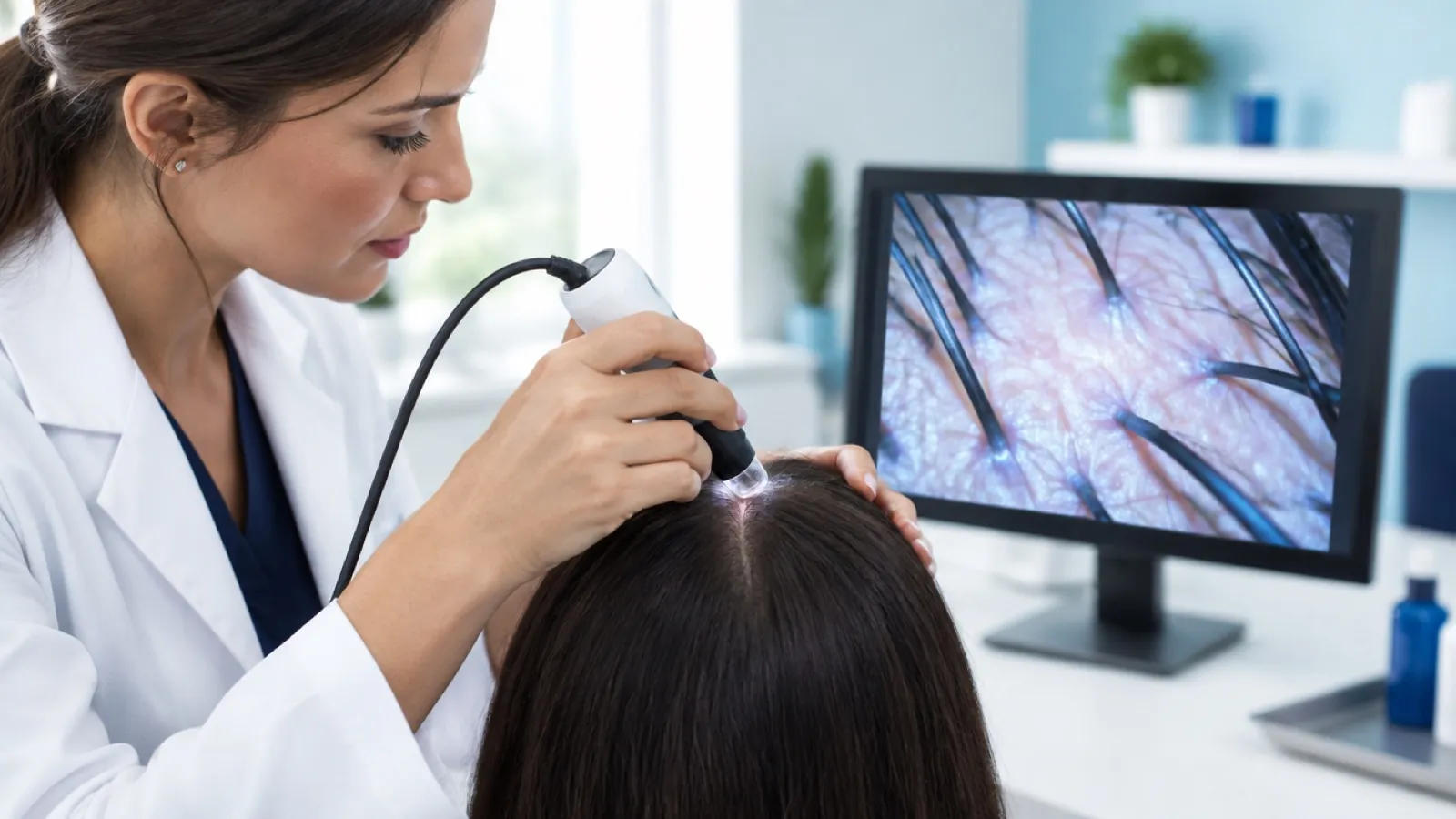
What Is Trichoscopy? Scalp Dermoscopy Explained
What is trichoscopy? A plain guide to scalp dermoscopy: how a trichoscope works, what it shows, who uses it, and how it compares with a biopsy or pull test.
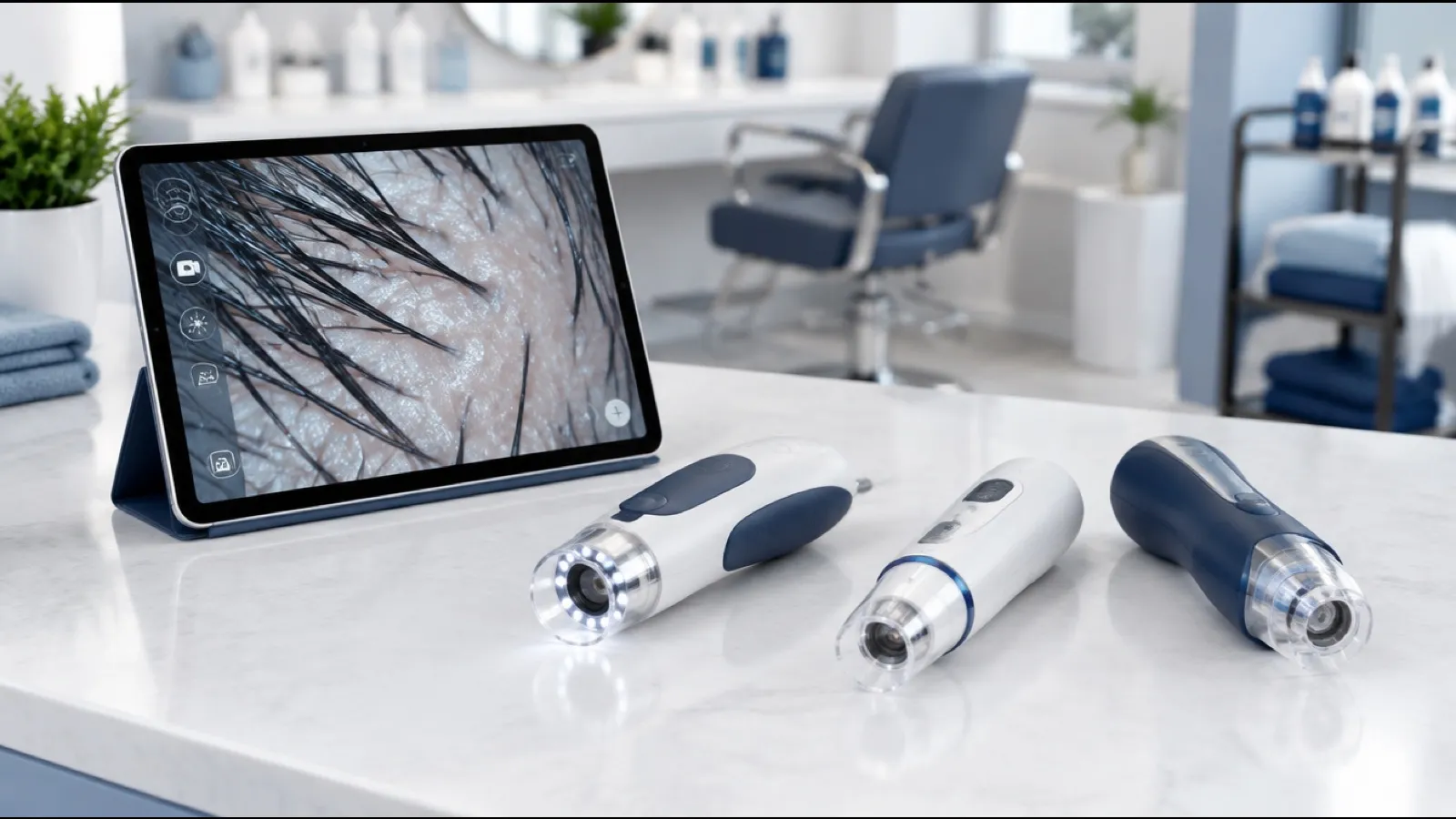
Best Scalp Camera for Salon Use: What to Compare First
The best scalp camera for salon use is the one that gives clear, repeatable images. Compare magnification, lighting, storage, display and tip hygiene.

How to Talk to a Client About Hair Loss: 6 Salon Scripts
How to talk to a client about hair loss: word-for-word scripts for six salon situations, a say-this-not-that table, privacy rules and referral wording.