

Associate Trichologist Certification: AMCA Exam Guide
Associate Trichologist Certification exam guide: AMCA format, 100 questions, 2 hours, remote proctoring, the seven topic areas and a four-week study plan.

The Associate Trichologist Certification (ATC) is a credential from the American Medical Certification Association (AMCA). The exam is 100 questions with a 2 hour time limit, delivered online, with live remote proctoring available. This guide reports what the AMCA publishes about the exam, shows how the topic areas are weighted, compares the ATC with the AMCA's Trichologist Certification, and lays out a study plan. Everything attributed to the AMCA below was read on its certification pages on October 3, 2026. Confirm current details with the AMCA before you register.
What is the Associate Trichologist Certification?
The Associate Trichologist Certification is a professional credential issued by the AMCA to candidates who pass its ATC exam. It tests knowledge of hair and scalp anatomy, hair composition, hair loss and scalp conditions, and client-facing skills. It is a certification, not a state license or a medical qualification.
That distinction matters. No US state licenses trichologists, and trichologists are not physicians. Holding the ATC does not allow anyone to diagnose, treat or prescribe. A certified professional's role is to recognize signs of a hair or scalp concern, support the client with education and cosmetic care within their license, and refer to a dermatologist or physician. The American Academy of Dermatology describes how dermatologists find the cause of hair loss, which can involve examining the scalp and ordering blood tests or a scalp biopsy. That work is medical. By contrast, the Bureau of Labor Statistics notes that all states license barbers, hairstylists and cosmetologists, and rules on which services need that license vary by state, so check with your state board. Our article on whether trichologists need a license covers this in detail.
Within USTI's trichology pathway, Associate Trichologist is the second of three steps. The Hair Loss Practitioner course comes first, and Clinical training follows. USTI's certification exams are through the AMCA.
What is the AMCA trichology exam format?
The AMCA lists the Associate Trichologist Certification exam as 100 questions with 2 hours allotted. The modality is online, and the AMCA states that live remote proctoring is available. On October 3, 2026, the page listed the exam at $299.00 with study material included. Verify all of this with the AMCA.
| Detail | What the AMCA page states (read October 3, 2026) |
|---|---|
| Credential | Associate Trichologist Certification (ATC) |
| Number of questions | 100 |
| Time allotted | 2 hours |
| Modality | Online |
| Live remote proctoring | Available |
| Listed cost | $299.00, study material included |
| Passing score | Not stated on the page |
| Eligibility requirements | Not stated on the page |
| Renewal requirements | Not stated on the page |
Three items are worth a direct question to the AMCA or your training provider, because the certification page does not spell them out: the passing score, who is eligible to sit the exam, and what is required to keep the credential active. The page links a Certification Program Outline and an Exam Blueprint, which are the right documents to read next.
What does 100 questions in 2 hours feel like?
It averages 72 seconds per question. That is enough time to read carefully but not enough to work out anatomy from scratch. The pacing favors candidates who know the vocabulary well.
What topics are on the associate trichologist exam?
The AMCA lists seven competency areas with a percentage for each. Anatomy and Physiology is the largest at 36 percent. Marketing and Sales is 17 percent and Hair Composition is 16 percent. Hair Loss Conditions, Treatment Alternatives, Effects of Drugs and Medications, and Scalp Conditions make up the remaining 31 percent.
| AMCA competency area | Share of exam | Approximate questions out of 100 |
|---|---|---|
| Anatomy and Physiology | 36% | 36 |
| Marketing and Sales | 17% | 17 |
| Hair Composition | 16% | 16 |
| Hair Loss Conditions | 11% | 11 |
| Treatment Alternatives | 9% | 9 |
| Effects of Drugs and Medications | 6% | 6 |
| Scalp Conditions | 5% | 5 |
The question counts in the last column are our arithmetic from the published percentages. The AMCA does not list them that way.
A few things stand out:
- Science carries the exam. Anatomy and Physiology plus Hair Composition account for 52 percent. A candidate who is weak on the structure of the follicle, the skin and the hair fiber will struggle regardless of how well they know hair loss patterns.
- Business skills are not filler. Marketing and Sales is the second largest area. Expect questions about client interaction and the professional side of the work.
- Topic names are the AMCA's. "Treatment Alternatives" and "Effects of Drugs and Medications" are exam knowledge areas. Knowing that certain medications are associated with shedding helps you ask good intake questions and refer appropriately. It does not mean a trichologist treats conditions or advises on medication.
Are trichologist certification exam questions available?
We did not find exam questions published on the AMCA's certification page, and you should be wary of any site selling "real" ones. What the page does list is study material included with the exam fee and a linked exam blueprint. Study from those and from your course notes. Memorized question dumps tend to fail when the wording changes.
How is the ATC different from the AMCA Trichologist Certification?
The Trichologist Certification (TC) is a separate, longer AMCA exam. It has 200 questions and an allotted time of 3 hours 30 minutes, and the AMCA lists it as available online or by paper and pencil. Its topic mix differs, with Product Knowledge at 21 percent and Scalp Disorders at 14 percent.
| Associate Trichologist Certification (ATC) | Trichologist Certification (TC) | |
|---|---|---|
| Questions | 100 | 200 |
| Time allotted | 2 hours | 3 hours 30 minutes |
| Modality | Online | Online, paper and pencil |
| Live remote proctoring | Available | Available |
| Largest topic area | Anatomy and Physiology (36%) | Anatomy and Physiology (24%) |
| Other listed areas | Marketing and Sales, Hair Composition, Hair Loss Conditions, Treatment Alternatives, Effects of Drugs and Medications, Scalp Conditions | Product Knowledge, Marketing/Client Interactions, Hair Composition, Scalp Disorders, Phases of Hair Growth, Effects of Drugs and Medicine |
| Listed cost on October 3, 2026 | $299.00, study material included | $399.00, study material included |
Ask the AMCA which exam matches your training and what the eligibility rules are for each.
How do you prepare for the associate trichologist exam?
Prepare by studying in proportion to the blueprint. Spend roughly half your time on anatomy, physiology and hair composition, since they make up 52 percent of the exam. Use the AMCA's study material and exam blueprint, review your course notes, and practice recalling terms without looking.
A four-week study plan
This plan assumes you have finished your coursework. Adjust it to your schedule.
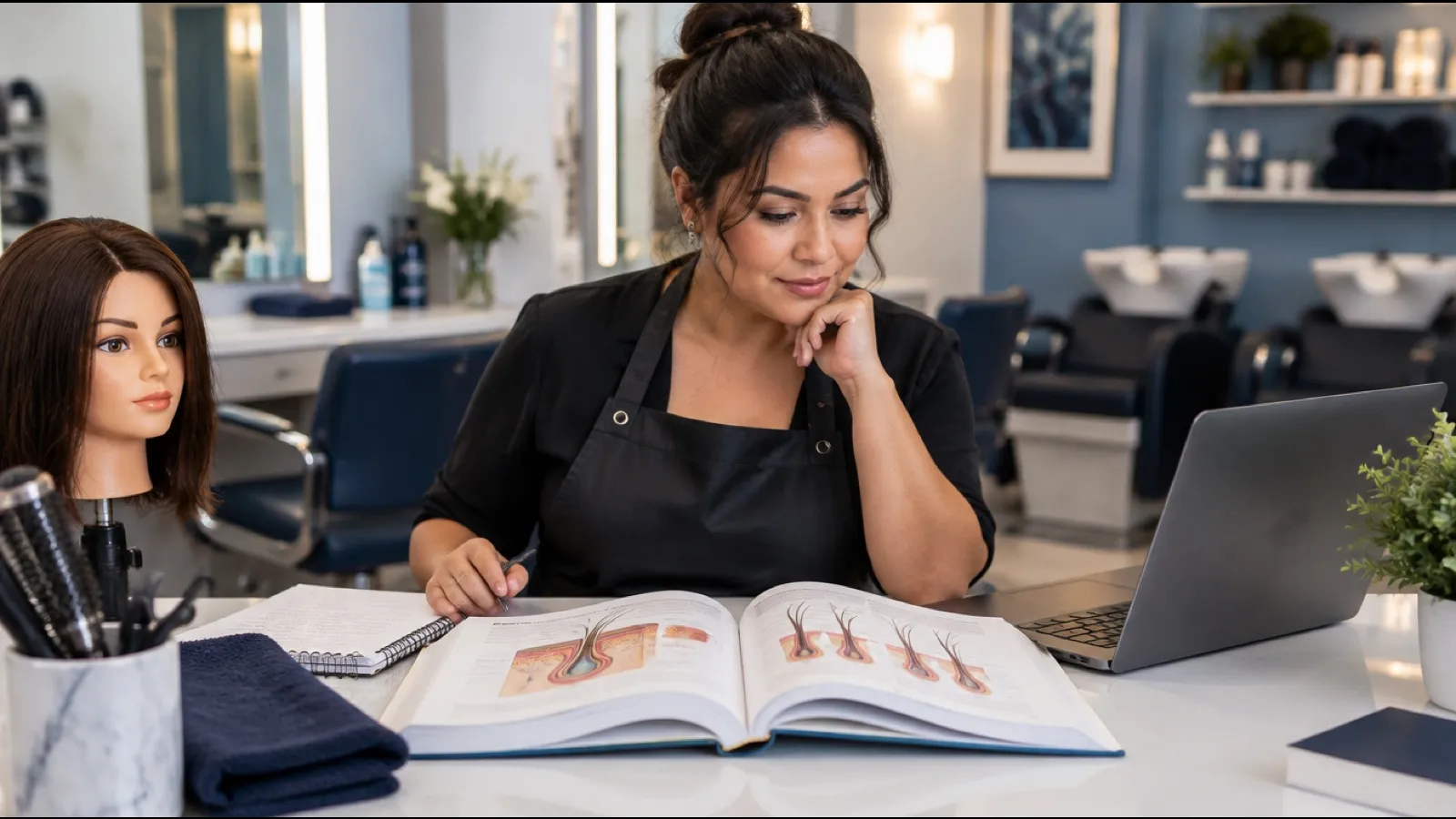
- Week 1: Anatomy and physiology. Skin layers, follicle structure, the dermal papilla, sebaceous glands, blood supply and the hair growth cycle. Draw the follicle from memory and label it. Our overview of the hair growth cycle stages is a useful refresher.
- Week 2: Hair composition, plus anatomy review. Keratin, the cuticle, cortex and medulla, bonds, and how chemical and heat services affect the fiber. Spend one session revisiting week 1.
- Week 3: Hair loss conditions, scalp conditions and medications. Learn how the common patterns present and which are associated with scarring. Review the types of hair loss for stylists. Focus on recognition and referral, not treatment.
- Week 4: Marketing and sales, treatment alternatives, full review. Cover consultation, client communication and ethics. Then do timed practice at 72 seconds per question and revisit every weak area.
Study habits that help
- Test yourself. Close the book and write what you remember. Recalling is harder than rereading, and it shows you what you do not know yet.
- Learn the vocabulary. Similar terms, such as anagen and telogen, are easy to confuse under time pressure.
- Use real scalps. If you have a scalp scope, connect what you study to what you see on clients.
- Ask questions early. A mentor or educator can clear up a misunderstanding in minutes. USTI offers mentorship for this reason.
- Prepare your exam setup. For a remotely proctored exam, confirm the technical and identification requirements with the AMCA ahead of time.
What happens after you pass?
After passing, you hold the ATC credential from the AMCA. You can then build consultation services within your license, continue to clinical training, and set up referral relationships with local dermatologists. Ask the AMCA how to maintain the credential, since renewal terms are not stated on the certification page.
The certificate is a starting point. Skill comes from doing consultations, documenting them and reviewing difficult cases with someone more experienced. For the wider career picture, see how to become a trichologist and is trichology certification worth it.
Key points to remember
The Associate Trichologist Certification exam is 100 questions in 2 hours, online, with live remote proctoring available, and more than half of it is hair and skin science. Study to the blueprint, confirm fees and rules with the AMCA, and remember what the credential is: proof of knowledge, not a license to practice medicine.
New to the field? Start with What is trichology? or look up a term in the trichology glossary.
Sources
Frequently asked questions
How many questions are on the Associate Trichologist Certification exam?
The AMCA lists 100 questions for the Associate Trichologist Certification (ATC) exam, with 2 hours allowed to complete it. That works out to a little over one minute per question. The AMCA can update exam details, so confirm the current question count and time limit on its certification page before you schedule.
Is the AMCA trichology exam taken online?
Yes. The AMCA lists the Associate Trichologist Certification exam modality as online and states that live remote proctoring is available. Remote proctoring means a person monitors your session by webcam. Ask the AMCA or your training provider about the technical requirements, identification rules and scheduling steps before exam day.
What topics are on the associate trichologist exam?
The AMCA lists seven competency areas: Anatomy and Physiology (36 percent), Marketing and Sales (17 percent), Hair Composition (16 percent), Hair Loss Conditions (11 percent), Treatment Alternatives (9 percent), Effects of Drugs and Medications (6 percent) and Scalp Conditions (5 percent). The AMCA also links an exam blueprint and program outline on the same page.
What is the difference between the ATC and TC exams?
They are two separate AMCA credentials. The Associate Trichologist Certification (ATC) exam has 100 questions and 2 hours. The Trichologist Certification (TC) exam has 200 questions and 3 hours 30 minutes, and adds areas such as Product Knowledge and Phases of Hair Growth. Check the AMCA site for eligibility and current details for each.
How much does the Associate Trichologist Certification exam cost?
On October 3, 2026, the AMCA's page listed the Associate Trichologist Certification exam at $299.00 with study material included. Fees change, and a training provider may bundle the exam differently. Confirm the current fee, what it covers and any retake charges directly with the AMCA before you register.
Does passing the exam make me a licensed trichologist?
No. The ATC is a professional certification from the AMCA, not a state license. No US state licenses trichologists, and the credential does not make you a medical provider. Which hands-on services you may offer still depends on your cosmetology or barber license and your state board's rules.
How long should I study for the associate trichologist exam?
There is no official study period. A reasonable plan is about four weeks of steady review after finishing your coursework, weighting your time toward the largest topic areas. Use the AMCA's exam blueprint and included study material as your guide, and adjust the schedule to how recently you covered the science.
This article is educational and is not medical advice. USTI teaches professionals to recognize, support and refer.
Turn this knowledge into a certification.
Learn hair and scalp science with USTI educators, from your first course to clinical training.
Explore trichology coursesRelated articles

Trichology vs Cosmetology: What Is the Difference?
Trichology vs cosmetology: how the two differ in focus, training, licensing and services, what cosmetology school teaches about the scalp, and how they combine.
Can a Cosmetologist Become a Trichologist? Yes: How
Can a cosmetologist become a trichologist? Yes. See the certification pathway for licensed stylists, what changes behind the chair, and how titles compare.
Do Trichologists Need a License? US Rules Explained
Do trichologists need a license in the US? Learn how certification differs from licensure, why state rules vary, and what a trichologist's scope covers.